Part IV — Advanced Two-Legged Hunting · 5 min read
Calendar and Diagonal Spreads — Selling Time

"There are two clocks running. One eats yours; one eats mine. Which one is faster?"
Calendar Spread — Same Strike, Different Times
Mechanic
-
Sell a near-term option (short leg).
-
Buy a longer-dated option of the same type and same strike (long leg).
-
Net debit (typically).
-
Profits when the underlying stays near the strike at near-term expiration and extrinsic value of the long leg is preserved.
Why It Works
The near-term option has higher theta per day than the longer-term option. As time passes, the near-term option decays faster. Selling time at the higher rate and owning it at the slower rate captures the difference.
Payoff at Near-Term Expiry
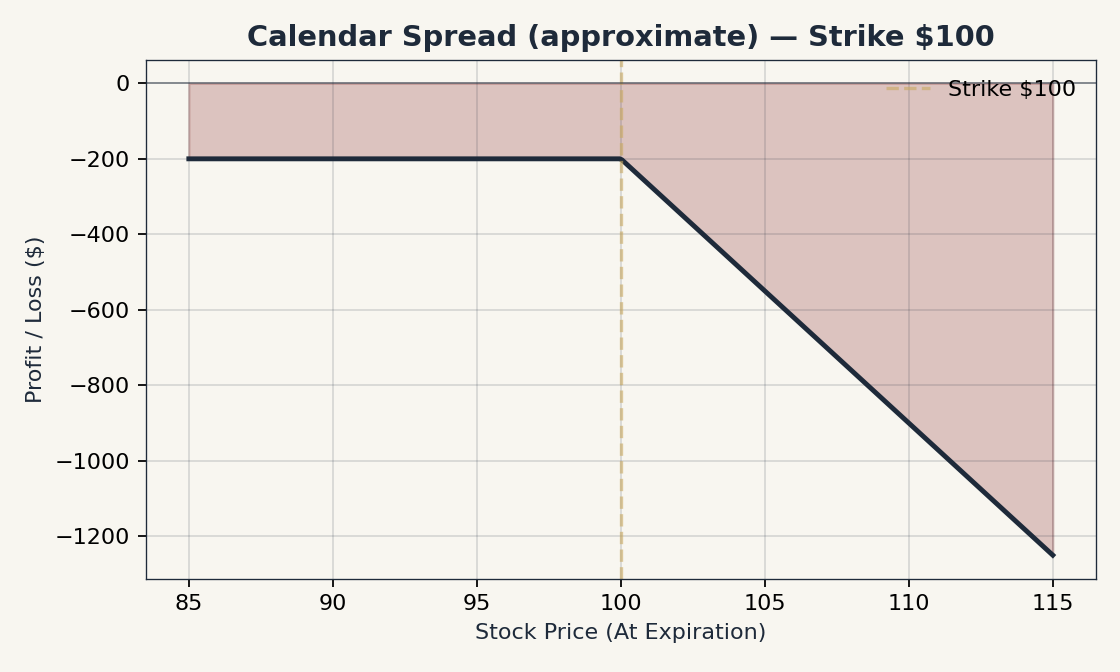
The classic "tent" shape: peak at the short-leg strike, falling off in either direction. Maximum profit occurs exactly at the short strike at the near-term expiration.
Vega Profile
A calendar is long vega (positive vega exposure). The long-dated leg has more vega than the short-dated leg. If IV rises, the calendar gains. If IV falls, the calendar loses — even if the underlying parks at the strike as planned.
This is why calendars work best when long-dated IV is low and you expect either stability or IV expansion. Conversely, calendars are terrible into earnings — the post-earnings IV crush hurts the long leg more than it helps the short leg (because the short leg is usually past the event already).
Diagonal Spread — Different Strike, Different Time
Mechanic
A diagonal is a calendar variation: same as calendar but with different strikes on the two legs. The most common form:
-
Buy a longer-dated, deeper-ITM option.
-
Sell a shorter-dated, more-OTM option of the same type.
This creates a directional bias (the long leg’s delta) while still benefiting from theta differential.
The Poor Man’s Covered Call (PMCC)
A specific diagonal that deserves its own mention. Instead of buying 100 shares of stock and selling a call (a true covered call), you:
-
Buy a 6-12 month LEAPS call deep ITM (delta 0.70-0.85) on the same underlying.
-
Sell a 30-45 DTE OTM call against the LEAPS.
The economics are similar to a covered call but with much less capital required. Compare:
-
Traditional covered call on AAPL at $175: requires ~$17,500 of stock.
-
PMCC on AAPL: buy a 12-month $150 LEAPS for ~$3,000, sell a 30-day $185 call for ~$1.00. Total capital: roughly $2,900.
Same theta-harvesting structure at ~1/6 the capital. Trade-off: the LEAPS has theta and vega exposure that pure stock does not.
The PMCC is covered in more detail in Chapter 19.
When to Use Calendar vs Diagonal
| Situation | Calendar | Diagonal |
|---|---|---|
You expect no direction, want pure theta |
Better |
Less ideal |
You have a moderate directional bias |
Less ideal |
Better |
You want capital efficiency (PMCC variant) |
N/A |
Better |
You expect IV expansion |
Both benefit |
Diagonal works too |
Earnings or major event before short expiry |
Avoid |
Avoid |
Greeks Profile
| Greek | Calendar Profile |
|---|---|
Delta |
~0 at the strike (neutral) |
Theta |
+ (your friend if structure plays out) |
Vega |
+ (long-dated leg vega > short-dated leg vega) |
Gamma |
− near short expiry (negative gamma risk if stock moves away from strike) |
Management
-
50% profit: take. The calendar’s optimal point is fleeting; harvest when you have it.
-
Stock moves away from strike: the tent flattens. Manage early.
-
Approaching short-leg expiry: roll the short leg to the next expiration, or close the entire structure.
-
Watch IV: a fall in long-dated IV can ruin the trade even if everything else is fine.
Common Mistakes
-
Opening calendars into earnings windows: vega crush wrecks the long leg.
-
Letting the short leg expire ITM: assignment ensues, you are now holding a stock position you did not size for.
-
Treating a calendar as "set-and-forget": the structure has a short timing window for optimal profit.
-
Ignoring net vega: a calendar is a vega bet. If you do not have a vega view, do not open the trade.