Part III — Core Hunting Techniques · 7 min read
Covered Call and Cash-Secured Put — The Pack’s Income

"Slow income, steady income. The pack feeds on discipline, not heroics."
The "Risk-Free Income" Lie — Say It First
The truth: covered calls and cash-secured puts shift some directional risk into premium collection. They do not eliminate risk. They reshape it.
Covered Call (CC) — The Pack’s Monthly Tip
Mechanic
-
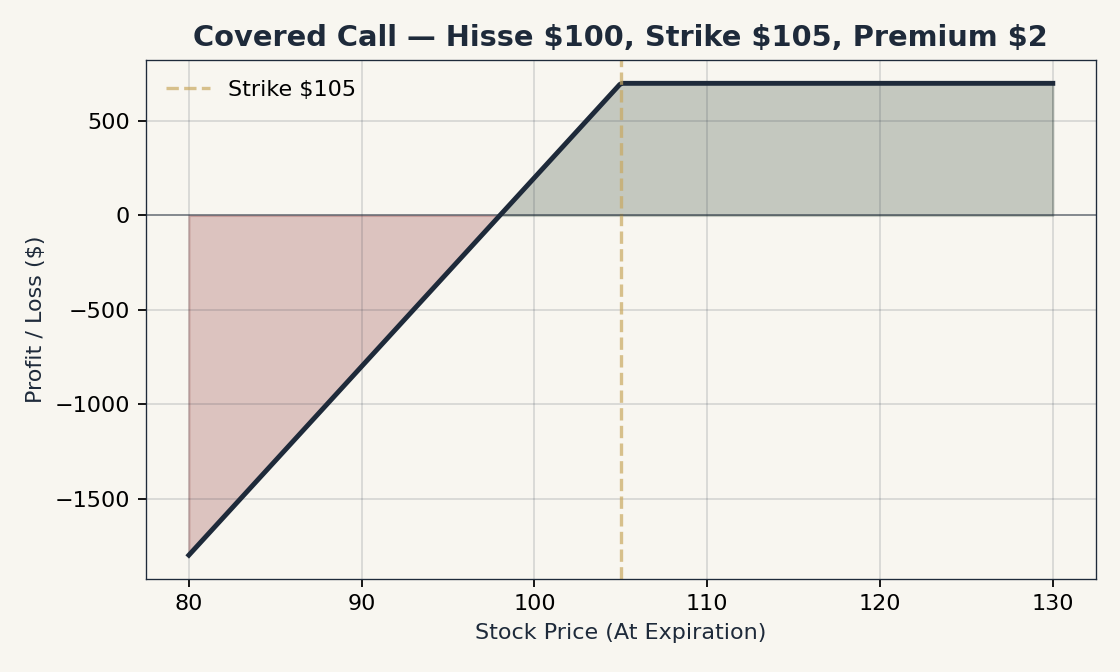
You own 100 shares of an underlying (for each contract).
-
You sell an OTM call against those shares.
-
If the stock stays below the strike, the call expires worthless, you keep the premium.
-
If the stock rises above the strike, your shares are called away (sold to the call buyer at the strike). You miss any further upside.
Strike Selection
-
Delta 0.20-0.30 → ~70-80% chance of staying OTM. Modest premium.
-
Closer-to-the-money strikes → richer premium but higher assignment risk.
-
Further OTM → minimal premium, less compelling.
The "right" delta depends on your view:
-
Pure income (you want to keep the shares): delta 0.15-0.20.
-
Income + willing to part with shares above target: delta 0.25-0.35.
-
Aggressive sell-the-rip: delta 0.40+ on overextended names.
Cash-Secured Put (CSP) — The Patient Hunter
Mechanic
-
You have cash equal to (strike × 100) set aside.
-
You sell an OTM put on a stock you would be happy to own at that strike.
-
If the stock stays above the strike, the put expires worthless, you keep the premium.
-
If the stock falls below the strike, the put is assigned — you must buy the stock at the strike.
|
A cash-secured put is a strategy to "buy a stock you already wanted, paid to wait." If you do not want the stock at the strike, you have no business selling the put — assignment will hand you a stock you never wanted, at a price the market has already deemed too high. |
The Wheel
The Wheel strategy is the continuous loop of CSPs and CCs:
-
Identify a stock you want to own long-term.
-
Sell a CSP. If it expires worthless, collect premium and repeat.
-
If assigned, you now own the stock.
-
Sell a CC on the stock. If it expires worthless, collect premium and repeat.
-
If called away, you no longer own the stock. Return to step 2.
The Wheel works if and only if you would be happy to hold the underlying through a drawdown. If you would panic-sell at -20%, the Wheel is the wrong strategy.
Greeks on These Strategies
| Greek | Covered Call | Cash-Secured Put |
|---|---|---|
Delta |
Long stock +1.0, short call −0.30 → net ~+0.7 (still long-biased) |
Short put → +0.30 (long-biased) |
Theta |
+ (in your favor — premium decays) |
+ (in your favor) |
Vega |
− (IV decay helps short option) |
− (IV decay helps short option) |
Gamma |
− (negative gamma intensifies near expiry) |
− (negative gamma intensifies near expiry) |
Both strategies are short volatility and short gamma. They make money in calm markets and lose money in violent moves — particularly violent moves against you.
Management
-
50% profit: A short option you sold at $1.00 is now $0.50. Close it. Why? Theta has decayed nearly half the extrinsic; the remaining $0.50 will take longer and longer to harvest, with rising gamma. Better to close and redeploy.
-
Loss management: A 100-200% loss (premium has doubled or tripled) is your typical "manage or cut" threshold. Roll out in time, roll out and down (for CSPs), or accept the loss.
-
21 DTE: Per the 21-DTE convention (see Chapter 10), short positions are typically closed or rolled at 21 days regardless of P&L, to avoid the gamma cliff.
-
Ex-dividend on CCs: monitor closely. If extrinsic value falls below upcoming dividend, your short call is a candidate for early exercise (Chapter 9).
-
Earnings: short premium into earnings is a popular play (you benefit from IV crush), but the directional risk is binary. Reserve this for advanced traders.
Common Mistakes
-
Selling CSPs on stocks you don’t want to own: when assigned, you hold a stock you hate. The premium does not compensate.
-
CCs too close to the money: assignment is frequent, upside is sacrificed cheaply.
-
Treating the Wheel as risk-free: A 30% drawdown on the stock is a 30% drawdown on the position, premium notwithstanding.
-
CCs going into ex-dividend: early assignment costs you the dividend.
-
Five CSPs in the same sector: in a sector sell-off, all five assign at once. You have effectively concentrated your account.
Tax Note
Brief and entirely informational, not advice (see Disclaimer):
-
Premium received on a short option that expires worthless is generally short-term capital gain (US individual taxpayer perspective).
-
Assignment on a short call (covered call) becomes part of the stock-sale price for cost-basis purposes.
-
Assignment on a short put (CSP) reduces the cost basis of the assigned shares.
-
Consult a tax professional. The above is a sketch, not gospel; rules differ by jurisdiction and entity.