0DTE Options Risk: What Same-Day Expiration Really Means
A 0DTE option — zero days to expiration — is a contract that expires the same trading session you hold it. The math that governs every option still applies, but compressed into a few hours it turns sharp: gamma is at its peak, theta decay is brutal, and the close is a hard deadline. This guide explains zero DTE options risk precisely — what changes near expiry, why, and how to read near-term gamma positioning before you take the trade.
What are 0DTE options?#
0DTE options are simply standard listed options on their final day of life. The term is not a special product — it describes any option whose expiration date is today. Because the major index and ETF complexes now list expirations on most or every weekday, there is almost always a same-day contract trading on names like SPX, SPY and QQQ. That daily availability, plus heavy volume, is what makes 0DTE a distinct way to trade rather than an occasional quirk of the calendar.
You will mostly find liquid same-day expirations on high-volume underlyings: broad-index products (SPX, the SPY and QQQ ETFs) and a handful of mega-cap stocks. Thin names rarely support genuine 0DTE trading, because the order book gets too sparse to enter and exit cleanly intraday.
Why same-day expiration changes the risk#
Buy a longer-dated option and a wrong call on timing can still recover; the contract has weeks for the thesis to play out. A same-day contract removes that buffer. By 4:00 PM ET the option is worth its intrinsic value and nothing else, so an out-of-the-money 0DTE position tends toward an all-or-nothing payoff: it either finishes in the money or expires worthless. That binary character is the core of zero DTE options risk, and it is why position sizing matters far more here than on a swing trade.
The other structural risk is liquidity late in the day. As the clock runs down, a contract with minutes of life left attracts fewer willing buyers, and bid-ask spreads widen. You can be directionally right at 3:45 PM and still struggle to exit at a fair price — the move in your favour does not guarantee a counterparty.
Gamma: small moves, large swings#
Gammameasures how fast an option’s delta changes as the underlying moves. It is largest for at-the-money options and rises sharply as expiration approaches. On the final day, a near-the-money 0DTE option behaves like a hair-trigger: a modest move in the underlying can flip it from nearly worthless to deep in the money and back. That is the source of the violent percentage swings 0DTE traders see — high gamma turns a small point move into a large change in contract value.
This cuts both ways. The same gamma that delivers fast gains erases them just as quickly, which is what makes these positions psychologically punishing and easy to mistime. It also matters at the market level: because 0DTE volume is so concentrated, the gamma that options dealers must hedge piles into the front of the curve. The illustrative term structure below shows how lopsided net gamma can be toward the same-day bucket.
Net gamma by expiration — illustrative
For how dealer hedging of that gamma feeds back into index behaviour, see SPX Net GEX Explained and Total Gamma Exposure.
Theta: time decay accelerates into the close#
Theta is the rate an option loses extrinsic (time) value as the clock runs. Decay is not linear — it accelerates as expiration nears, and on the final day it is at its steepest. A 0DTE option that stays out of the money bleeds value hour by hour even if the underlying does not move at all, because the time value supporting that price is evaporating. Waiting for a late reversal that never comes is the most common way 0DTE buyers lose: the position simply decays to zero around them.
Theta acceleration into expiry — illustrative
Pin risk, assignment and liquidity#
Surviving the afternoon does not guarantee a clean close. If the underlying settles near your strike, you face pin risk: the uncertainty over whether a barely-in-the-money option exercises or expires worthless. For physically settled options that means you may end up assigned — obligated to buy or deliver 100 shares per contract, which can require capital you did not intend to commit. Index options like SPX are cash-settled, which removes the share-delivery problem but not the uncertainty of where the index prints at the close. The simplest control is in your hands: close the position before the bell rather than letting it settle.
| Risk | What it means on expiration day |
|---|---|
| Gamma risk | Delta changes fast near the strike, so small underlying moves cause large swings in the option's value — gains and losses both arrive quickly. |
| Theta / time decay | Extrinsic value evaporates fastest on the final day; an out-of-the-money position can decay to zero even if price is flat. |
| Pin risk | When the underlying settles near the strike, it is unclear whether the option finishes in or out of the money — an unhedged surprise at the close. |
| Liquidity / slippage | Spreads widen and depth thins late in the day, so exiting a winning position at a fair price can be hard. |
| Assignment | For physically settled options, finishing in the money triggers an obligation to buy or deliver 100 shares per contract; cash-settled index options avoid this. |
Reading 0DTE positioning before you trade#
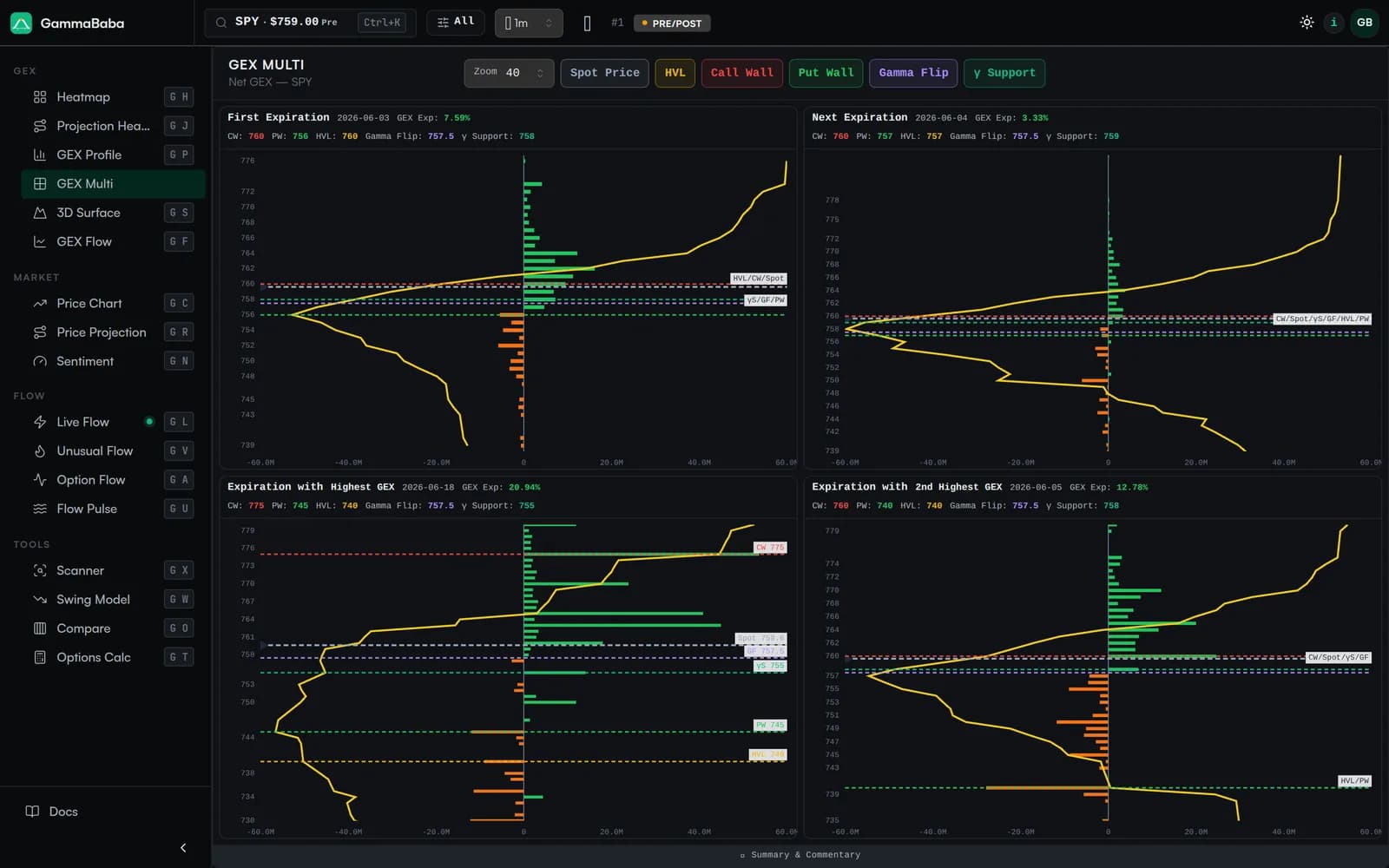
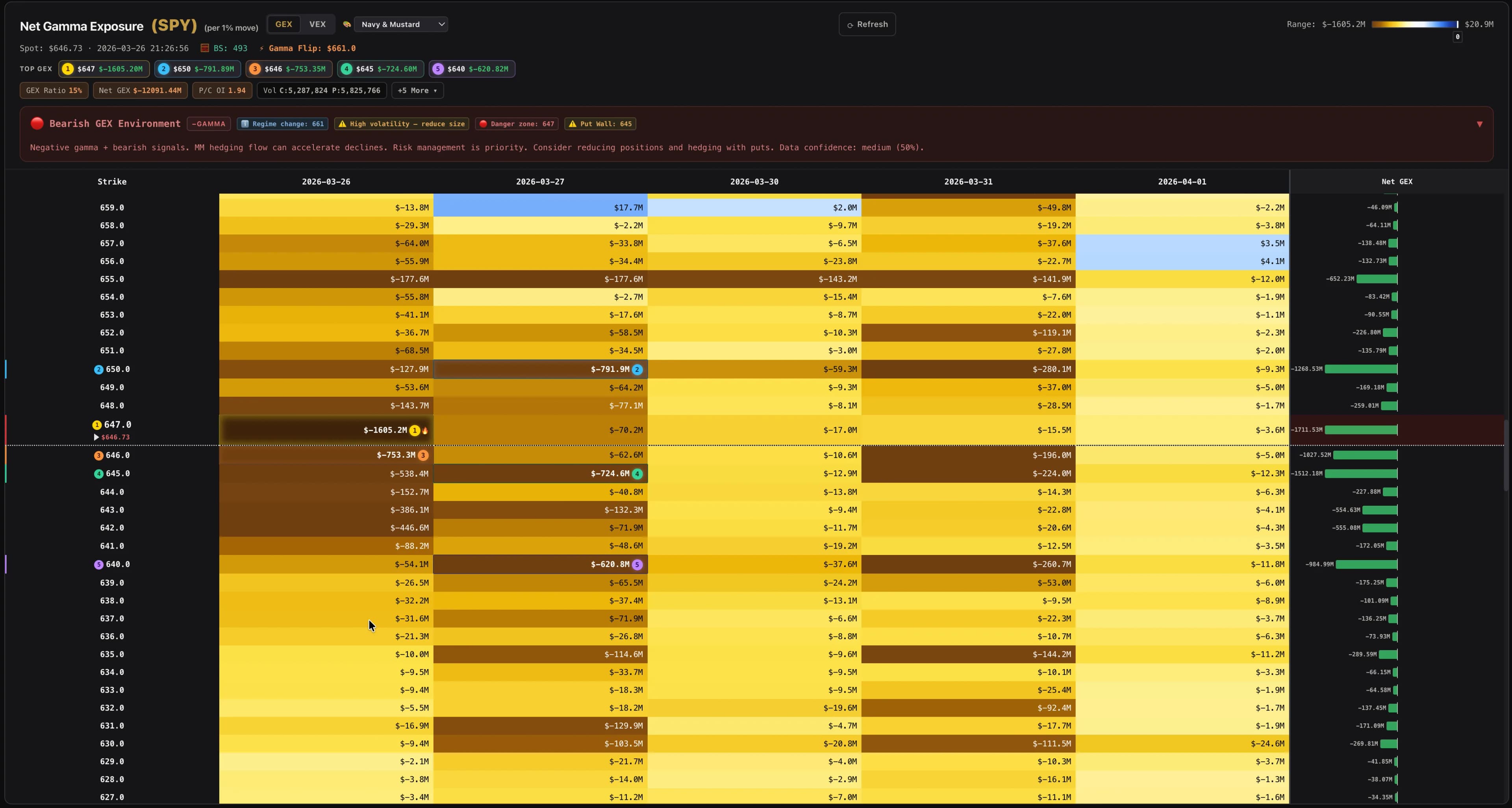
Because so much gamma sits in the same-day bucket, the most useful pre-trade context is a map of where that near-term gamma is concentrated. Stacked positive gamma above price tends to act as a ceiling where dealer hedging sells strength; stacked negative gamma below tends to accelerate declines once price breaks through. Knowing those levels does not tell you what to do, but it tells you where moves are likely to stall or speed up — exactly the information a 0DTE trader needs.
GammaBaba derives gamma exposure across the US options universe and refreshes it through the session. The GEX Multi-Panel lets you isolate the same-day expiration and line it up against later ones, while the heatmap shows the strike-by-strike structure for any optionable ticker.
Managing the risk if you trade 0DTE#
Same-day options are high-speed instruments, not lottery tickets, and they reward discipline far more than conviction. A workable approach to how to trade 0DTE options starts with sizing each position so a full loss is survivable, because a worthless expiration is a routine outcome, not a tail event.
- Size small. Treat every 0DTE buy as capital you can lose in full, and keep each position a small fraction of your account.
- Define the exit first. Decide your stop and your profit target before entry; high gamma makes mid-trade decisions emotional and slow.
- Close before the bell. Flatten near-the-money positions ahead of 4:00 PM to sidestep pin risk and assignment.
- Respect liquidity. Trade only names with deep order books, and assume spreads will be worse than they look late in the day.
- Map gamma first. Know where the near-term call and put walls sit so you are not surprised when price stalls or accelerates.
Frequently asked questions
What are 0DTE options?
0DTE options are standard listed options on their final day of trading — zero days to expiration. They are not a special product; the term just means the contract expires the same session you hold it. Major index and ETF complexes now list same-day expirations on most or every weekday, which is why 0DTE trading on names like SPX, SPY and QQQ is so common.
Why is zero DTE options risk so high?
On expiration day every option sensitivity is near its extreme. Gamma is at its peak, so small moves in the underlying cause large swings in the contract's value. Theta decay is at its steepest, so time value evaporates fast. And an out-of-the-money 0DTE position tends toward an all-or-nothing outcome, finishing either in the money or worthless by the close.
What is pin risk on 0DTE options?
Pin risk is the uncertainty that arises when the underlying settles very close to your strike at expiration. It becomes unclear whether the option finishes in or out of the money, which can leave you unexpectedly assigned on physically settled options. The simplest way to avoid it is to close the position before the market closes rather than letting it settle.
How do you trade 0DTE options more safely?
Size each position so a total loss is survivable, define your stop and target before entry, and close near-the-money positions before the 4:00 PM close to avoid pin risk and assignment. Trade only liquid underlyings, and check where near-term gamma is concentrated so you understand where price is likely to stall or accelerate.
Can you lose more than you paid on a 0DTE option?
If you only buy options, your maximum loss is the premium paid. The larger danger is assignment: on physically settled options, an in-the-money position at expiration obligates you to buy or deliver 100 shares per contract, which can require far more capital than the premium. Cash-settled index options like SPX avoid share delivery but still settle to an uncertain closing level.
Does 0DTE gamma affect the broader market?
Yes. Because same-day options now make up a large share of index option volume, the gamma that dealers must hedge concentrates in the front of the curve. That can dampen intraday moves when dealers are long gamma and amplify them when they are short, which is why near-term positioning increasingly shapes intraday index behaviour.