How to Read Stock Charts: Patterns, Trends & Volume
A stock chart is a visual record of supply, demand and sentiment over time. Learning how to read stock charts means reading three things at once: the trend (where price is going), the structure (the levels and chart patterns that form along the way), and the volume that confirms or contradicts a move. This guide walks through each, then shows how options gamma can tilt the very moves you are trying to read.
Start with the building blocks: OHLC and candlesticks#
Every chart, no matter the timeframe, is built from the same four numbers per period: the open, high, low and close (OHLC). A candlestick draws those four into one shape. The thick body spans the open and close; the thin wicks reach to the high and low. A close above the open is usually drawn green (buyers won the period); a close below the open is red (sellers won).
That single shape already carries information. A small body with long wicks says the period was a fight with no clear winner — indecision. A long body with little wick says one side dominated from open to close. Knowing how to read share chart data starts with reading candles, not lines: the line chart only shows the close and throws away the struggle inside each period.
Read the trend first#
Before hunting for patterns, answer one question: is the asset moving up, down, or sideways? An uptrend is a sequence of higher highs and higher lows; a downtrend is lower highs and lower lows; a range oscillates between a floor and a ceiling. The trend is the context that tells you whether a pattern is trading with the dominant flow or against it.
The most reliable structure on any chart is where price has repeatedly turned — support and resistance. Support is a floor where buyers have stepped in before; resistance is a ceiling where sellers have. Mark those horizontal levels before anything else, because most chart patterns are just price interacting with them. The illustrative path below shows an uptrend repeatedly using a prior resistance level as new support after it breaks through.
Trend with support & resistance — illustrative
The classic stock chart patterns#
Once the trend and levels are marked, you can read the geometry. Trading chart patterns are recurring shapes that reflect the same crowd psychology playing out again and again — accumulation, distribution, consolidation and breakout. None of them are guarantees; they are odds, and they work best when volume and the broader trend agree. Here are the formations worth knowing first.
| Pattern | What it looks like | Typical read |
|---|---|---|
| Head & Shoulders | Three peaks — a higher middle peak (head) between two lower ones (shoulders), sharing a neckline. | Reversal of an uptrend. A close below the neckline signals a potential top. The inverse version signals a bottom. |
| Double Top / Bottom | Two failed pushes to the same high (top) or low (bottom), forming an ‘M’ or ‘W’. | Reversal. The level held twice; a break of the middle pivot confirms the turn. |
| Triangle | Converging trendlines — ascending, descending or symmetrical — as range tightens. | Continuation or breakout. Tightening range stores energy; trade the direction of the break. |
| Flag | A sharp move (the pole) followed by a small, tilted consolidation channel. | Continuation. Often resolves in the direction of the pole after a brief pause. |
| Cup & Handle | A rounded ‘U’ recovery, then a small dip (the handle) near the prior high. | Bullish continuation. A breakout above the rim on volume targets a new leg up. |
Volume: the confirmation layer#
Price tells you what happened; volume tells you how much conviction was behind it. A breakout on heavy volume is far more credible than the same breakout on thin volume, which often fades. As a rule of thumb, you want volume expanding in the direction of the move and contracting during consolidation. The illustrative session profile below shows the typical intraday shape: a heavy open, a quiet midday lull, and a heavy close.
Volume by session block — illustrative
Volume also explains why timing matters when you are learning how to read stock charts for day trading. Day trading chart patterns play out over minutes, not weeks, and they hold best when liquidity is deep — near the open and the close. A clean-looking triangle in the thin midday lull can resolve into a fake-out simply because there were not enough orders to sustain the break.
A practical reading checklist#
Put the layers together and reading a chart becomes a repeatable routine rather than a guessing game. Work top-down, from context to trigger.
- Zoom out first. Check the daily or weekly trend so you are not trading against the dominant direction on a short timeframe.
- Mark the levels. Draw support and resistance where price has actually turned before you look for any pattern.
- Identify the pattern. Name the shape and the trend it sits in — continuation or reversal — and define the price that confirms it.
- Demand confluence. Require volume, trend and at least one level to agree before acting. One signal alone is noise.
- Define your risk. Place the stop where the pattern would be proven wrong, and size the position from that distance — not the other way around.
The hidden layer: how options gamma shapes the chart#
Here is what most chart guides miss. The candles you read are not drawn by retail sentiment alone — they are partly shaped by options dealers hedging their books. When dealers are long gamma, their hedging sells into rallies and buys into dips, which dampens moves and tends to pin price near big strikes. That is why a chart can stall politely at a round number and chop sideways even when the news looks bullish.
When dealers are short gamma, the reverse happens: hedging buys strength and sells weakness, which amplifies moves. The same breakout that would have faded in a positive-gamma regime can run hard in a negative-gamma one. So a pattern that “should” have failed sometimes accelerates — not because the chart lied, but because the hedging flow underneath it flipped. Knowing the gamma backdrop tells you whether to expect mean-reverting chop or trending follow-through. For the full mechanics, see Total Gamma Exposure and the docs guide on GEX patterns.
Read charts and gamma together on GammaBaba#
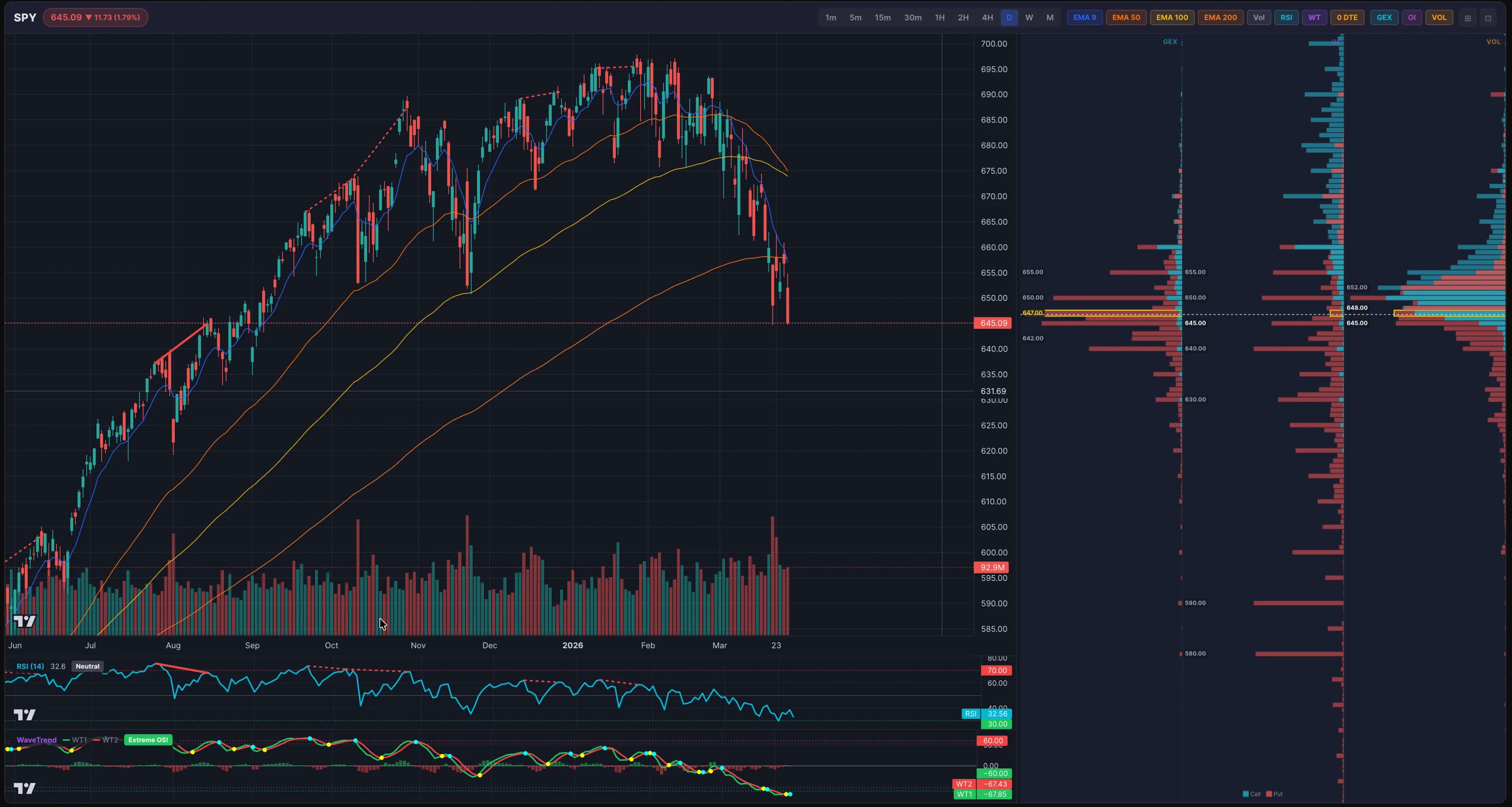
GammaBaba’s Chart View puts candlesticks, trend and volume next to the options structure that is shaping them. You can mark support and resistance, watch a pattern build, and at the same time see the call and put walls, the King Strike and the gamma flip that dealers are hedging around. The GEX heatmap shows that gamma structure across strikes and expirations for any optionable ticker.
Frequently asked questions
How do you read stock charts as a beginner?
Start with the trend: decide whether price is making higher highs and higher lows (uptrend), lower highs and lower lows (downtrend), or moving sideways (range). Then mark support and resistance where price has turned before. Read individual candlesticks for the open, high, low and close of each period, and use volume to judge how much conviction is behind a move. Work from this broad context down to a specific setup rather than reacting to any one candle.
What are the most common stock chart patterns?
The classics are head and shoulders (a reversal), double top and double bottom (reversals), triangles (continuation or breakout as range tightens), flags (continuation after a sharp move), and cup and handle (bullish continuation). Each reflects a stage of crowd psychology — accumulation, distribution, consolidation or breakout — and works best when volume and the broader trend agree.
How do you read stock market graphs using volume?
Volume confirms price. You want volume expanding in the direction of a breakout and contracting during quiet consolidation. A breakout on heavy volume is far more credible than the same move on thin volume, which often fades. Volume also clusters at the open and the close, so breakouts that happen in the thin midday lull are more prone to fail.
What are the best day trading chart patterns?
Day traders favour fast continuation patterns like flags and tight triangles that resolve within minutes to hours, plus failed-breakout reversals at clear support and resistance. The key is liquidity: these setups hold best near the open and the close when volume is deep, and they fake out more often during the midday lull. Always pair a pattern with a stop-loss because no pattern is reliable enough to trade without defined risk.
How do options affect the stock chart I'm reading?
Options dealers hedge their positions by buying and selling the underlying, and that hedging flow shapes price action. When dealers are long gamma, their hedging dampens moves and tends to pin price near large strikes, producing chop and stalls. When they are short gamma, hedging amplifies moves, so breakouts run harder. Knowing the gamma backdrop helps you judge whether to expect mean-reverting ranges or trending follow-through.
Which timeframe should I use to read a stock chart?
Match the timeframe to your holding period, but always check a higher one first. Day traders read minute and 5-minute charts, swing traders use hourly and daily, and investors use daily and weekly. Whatever you trade, zoom out to the daily or weekly trend before acting so you are not fighting the dominant direction on a short timeframe.