10 Common Options Trading Mistakes (and How to Avoid Them)
Options trading rewards leverage and punishes carelessness in the same breath. Because option contracts bundle direction, time and volatility into one price, a single oversight can turn a sound thesis into a loss. These are the ten mistakes that drain the most accounts — each paired with a concrete fix and the GammaBaba tool that helps you avoid it.
The ten mistakes at a glance#
Most blow-ups are not exotic. They cluster around the same handful of habits: betting too big, paying for inflated volatility, letting time decay eat a position, and trading without an exit. The table below is the short version; the sections that follow unpack the ones that cost the most.
| Mistake | Why it hurts | The fix |
|---|---|---|
| Oversizing a position | One bad trade can wipe out weeks of gains; leverage cuts both ways. | Risk a fixed, small slice of equity (often 1–5%) per idea. |
| Ignoring theta | Long options bleed extrinsic value every day, especially near expiry. | Buy more time than you think you need, or sell premium to put theta on your side. |
| Buying into IV crush | Pre-event implied volatility is inflated; it collapses after the news. | Check IV rank first; avoid long premium into earnings unless vega-aware. |
| No exit plan | Greed turns winners into losers and hope turns small losses into large ones. | Pre-set profit targets and a stop before you enter. |
| Chasing 0DTE | Same-day options are pure gamma — fast, binary, and unforgiving. | Size tiny, define risk, and treat it as a separate sleeve. |
| Crossing wide spreads | Market orders on illiquid strikes hand the spread to the maker. | Use limit orders; price at or near the mid. |
| Ignoring liquidity / OI | Thin open interest means slippage in and a trap on the way out. | Favor strikes with tight spreads and healthy open interest. |
| Holding naked through earnings | Undefined risk plus a volatility shock is how accounts implode. | Define risk with spreads, or close before the print. |
| No probability check | Cheap out-of-the-money lottery tickets usually expire worthless. | Read delta as rough odds; weigh payoff against probability of profit. |
| Revenge trading | Forcing trades to win back losses compounds the damage. | Step away, journal the loss, and trade your plan — not your emotions. |
Mistake 1 — Oversizing and ignoring risk#
The fastest way to drain an account is to bet too much on one idea. The leverage in options trading means a position that looks small in premium can carry enormous notional exposure. Selling a naked put is the textbook example: you collect a little credit up front and take on the full downside of the stock if it falls. The payoff below shows a single short 100-strike put sold for $3.00 — pleasant near the strike, brutal as price drops toward zero.
Naked short put — small credit, large downside (one contract)
Mistakes 2 & 3 — Theta decay and gamma near expiry#
Options are decaying assets. Every day you hold a long contract, theta erodes a slice of its extrinsic value, and that bleed accelerates into expiration. Being right on direction is not enough if the move arrives too slowly. The fix is to buy more time than the thesis seems to need, or to flip the script and sell premium so theta works for you instead of against you.
The flip side is gamma. As expiry nears, an option’s delta becomes hyper-sensitive to small moves in the underlying, so the position can swing violently in the final days. Rolling out to a later expiration or closing the week before expiry tames those last-minute lurches. For how this same gamma drives dealer hedging at the index level, see Total Gamma Exposure.
Mistake 4 — Trading into IV crush#
Stock movement is only half of an option’s price; implied volatility (IV) is the other half. The classic rookie error is buying calls or puts the day before an earnings report, paying a premium inflated by pre-event IV. The morning after, the uncertainty resolves and IV collapses — the so-called IV crush. Traders are routinely right about the direction of the move and still lose money because the inflated premium evaporated underneath them.
The rule of thumb is simple to state and easy to forget: prefer buying options when IV is low and selling when IV is high, and always check where current IV sits in its own range before paying up. Defined-risk structures like spreads also blunt the impact of a volatility shock.
Mistakes 5–7 — 0DTE, liquidity and execution#
Three execution mistakes travel together. Chasing 0DTE contracts means trading pure, expiring gamma — exciting, but closer to a coin flip than a position; if you trade them at all, size tiny and define your risk. The mechanics and the math are covered in 0DTE Options Risk.
- Ignoring liquidity and open interest. Thin strikes have wide bid/ask spreads. You overpay getting in and get trapped trying to get out. Favor contracts with healthy open interest and tight quotes.
- Using market orders. Options spreads are far wider than stock spreads, so a market order can hand the maker an ugly fill. Use limit orders priced at or near the mid and dictate your own price.
- Skipping the probability check. Cheap out-of-the-money contracts are cheap because they rarely finish in the money. Read delta as a rough probability and weigh the headline payoff against realistic odds.
Mistake 8 — Trading in a vacuum, no plan, no context#
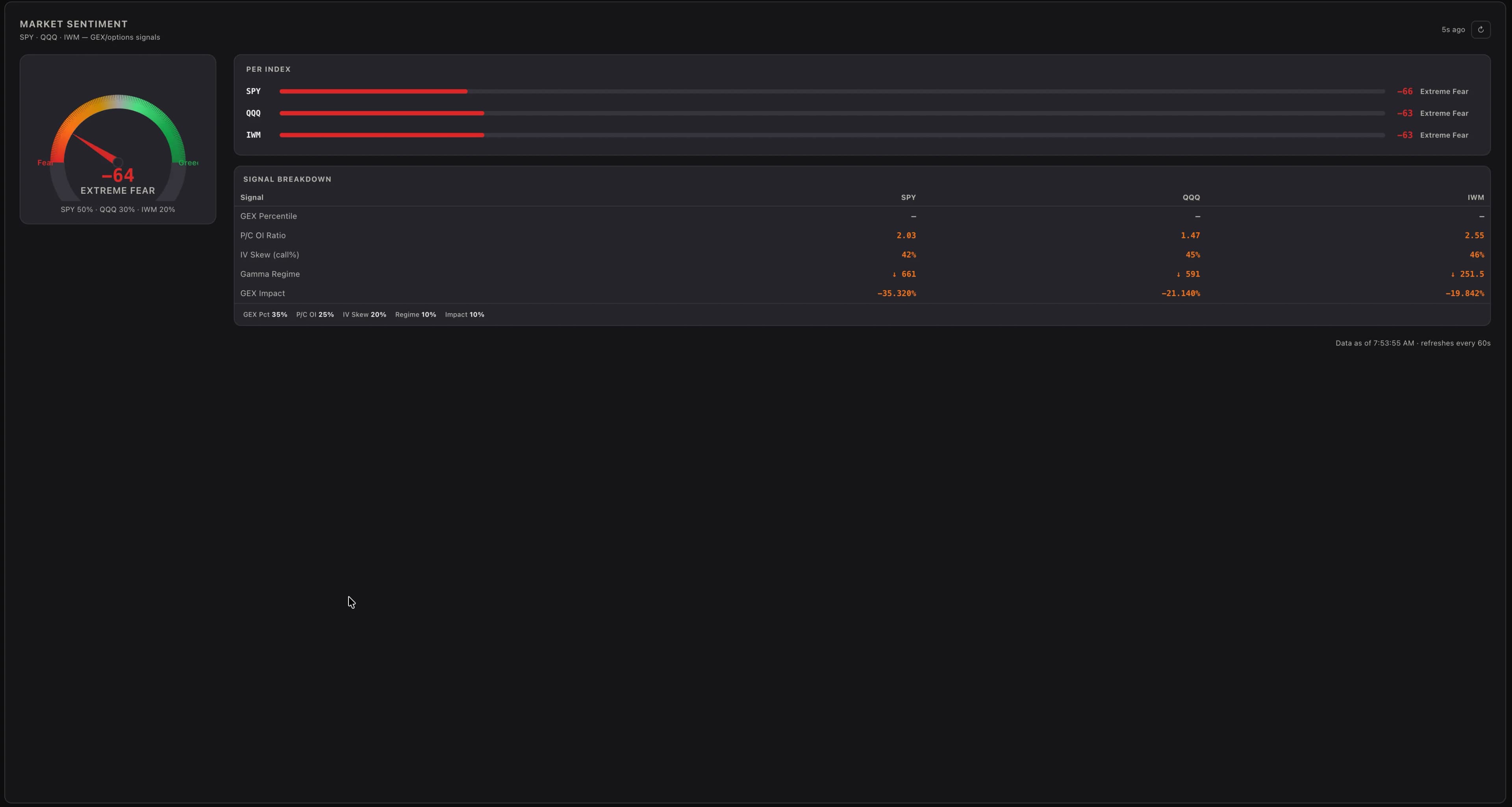
Great ideas die from poor execution and missing context. Before entering, know exactly where you take profits and where you cut losses — closing a long option around a target percentage, or a short around a smaller one, keeps greed from turning a winner into a loser. And no single setup lives in isolation: the broader market mood matters. A stretched put-call ratio, for instance, can flag extreme fear (a possible contrarian signal) or complacency.
GammaBaba’s Sentiment view rolls up positioning and flow into a single read of whether the tape is leaning bullish or bearish, so you size and time entries with the backdrop in view rather than against it.
Mistakes 9 & 10 — Revenge trading and no journal#
The most destructive mistakes are psychological. After a loss, the instinct is to win it back immediately. Revenge trading leads to reckless sizing, forced setups and doubled-down losses — the same error compounding. The antidote is mechanical: step away, then let your written rules, not your mood, decide the next trade.
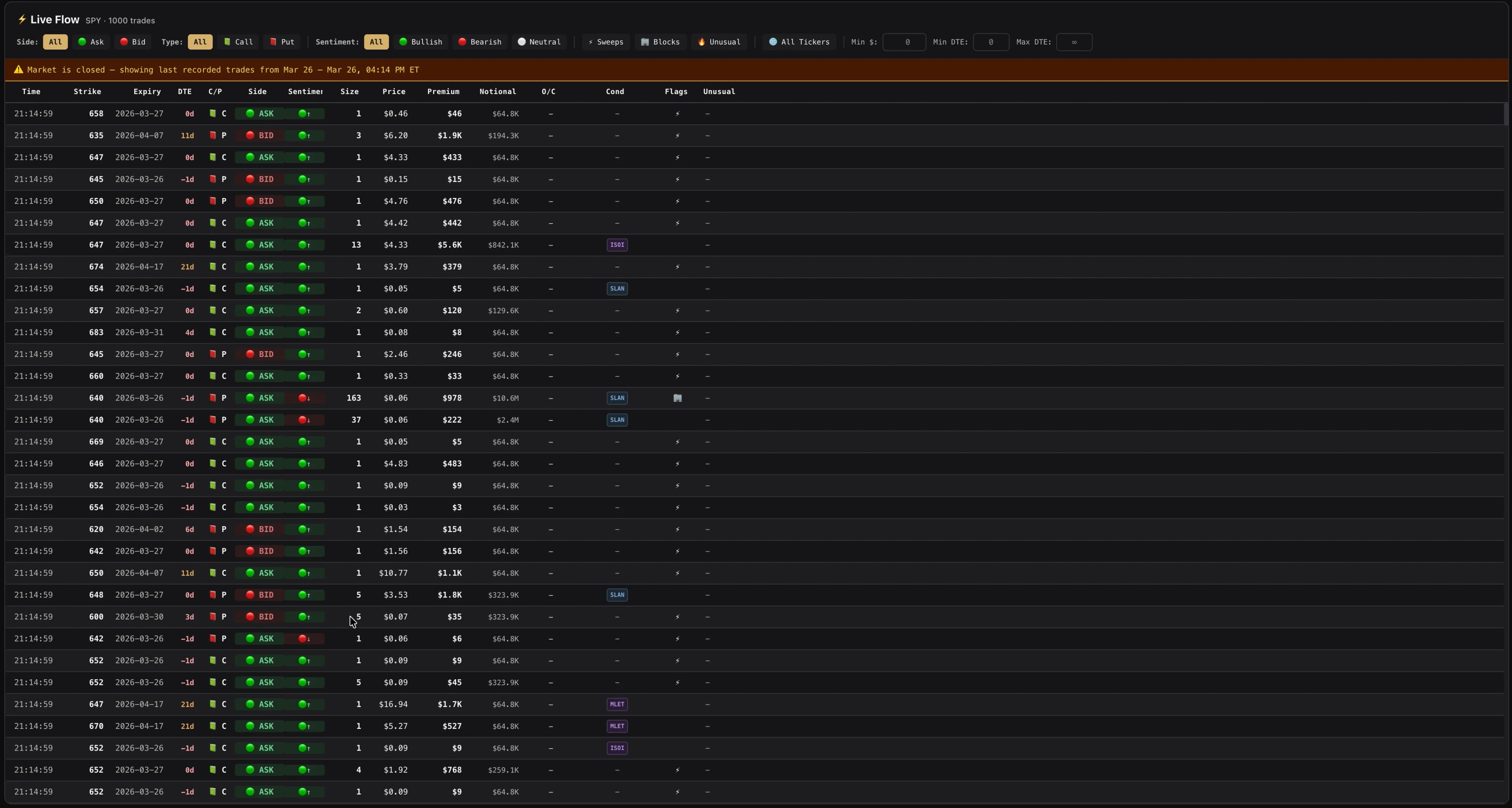
A consistent trading journal turns random losses into data. Log your entry, exit, strategy, the market conditions and your emotional state, and patterns surface that you can fix. Watching real-time order flow also keeps you honest about what the market is actually doing, rather than what you wish it were. GammaBaba’s Live Flow streams large and unusual option prints as they happen, so you can see where conviction is showing up across the US options universe.
Build a repeatable options trading system#
None of these fixes are clever; they are disciplined. A durable options trading system is mostly a checklist applied to every trade: size small, check IV before paying premium, buy enough time, demand liquidity, set an exit, mind the broader sentiment, and journal the result. Run the payoff and Greeks through the Options Calculator before you enter, and read the related guides on the options calculator and total gamma exposure to sharpen the inputs.
Frequently asked questions
What is the most common mistake in options trading?
Oversizing positions and ignoring risk management is the most common and most damaging mistake. Because options carry heavy leverage, committing too much capital to one idea means a single loss can erase weeks of gains. A common guideline is to risk only a small fixed slice of account equity, often 1 to 5 percent, on any single trade and to spread exposure across sectors, strategies and expirations.
Why do most out-of-the-money options expire worthless?
Out-of-the-money options are cheap because they have a low statistical probability of ever reaching their strike before expiration. The large percentage gains look appealing, but consistently buying deep out-of-the-money contracts is a losing strategy over time. Reading the option's delta as a rough probability of finishing in the money helps you judge whether a cheap contract is actually worth buying.
What is IV crush and how do I avoid it?
IV crush is the sharp drop in implied volatility that happens right after a scheduled event such as an earnings report. Pre-event premiums are inflated by uncertainty, so a long option can lose value the moment the news lands even if the stock moves the right way. Avoid it by checking where implied volatility sits in its range before buying, avoiding long premium into earnings, or using defined-risk spreads.
How do I avoid losing money to theta decay?
Theta is the daily loss in an option's extrinsic value, and it accelerates as expiration approaches. To limit it, buy longer-dated options that give your thesis time to play out, or sell premium so that time decay works in your favor instead of against you. Modeling profit and loss across both price and time before entering shows exactly how much a slow move will cost.
Are naked options or spreads safer for managing risk?
Vertical spreads are far safer for defined-risk trading. A naked option, especially a short one, exposes you to large or effectively unlimited losses and full volatility shocks. A spread caps the maximum loss and lowers the upfront cost by giving up some of the potential profit. For most traders, defining risk with a spread is the more sustainable choice.
How does watching options flow help avoid mistakes?
Real-time options flow shows where large and unusual trades are printing across the market, which provides context that isolated chart setups miss. Seeing genuine conviction, and pairing it with a sentiment read, helps you avoid trading against the broader tape, chasing illiquid contracts, or forcing emotional revenge trades after a loss.