The Option Chain Explained: Strikes, OI, Volume & Greeks
An option chain is the full quote table for one underlying — every strike and expiration, with the prices and statistics that describe each contract. It looks dense at first, but each column answers a specific question: what level are you betting on, what will it cost, how liquid is it, and how will it move. This guide walks through every field in option chain data so you can read the table and pick contracts with confidence.
What an option chain is#
Picture a stock trading at $100. Rather than buying shares, an option chain lets you browse contracts defined by three variables: a strike price (the level you are betting on), an expiration date (your deadline), and a direction (a call to profit from a rise, a put to profit from a fall). The chain lays all of those out in a grid so you can compare them side by side.
Most platforms split the table down the middle: calls on one side, puts on the other, with the shared strike prices running down the center. Each row is a single contract, and the columns are the options data that describe it — bid, ask, implied volatility, the Greeks, open interest and volume. Read across a row and you have the complete picture of one tradable contract.
A worked example: the option chain at $100#
Below is an illustrative call-side option chain for a stock trading at $100, with strikes from $95 to $110. The same columns appear on the put side, mirrored. Use it as a reference while we define each field.
| Strike | Bid | Ask | IV | Delta | Open Interest | Volume |
|---|---|---|---|---|---|---|
| $95 | 5.55 | 5.75 | 31% | 0.82 | 4,120 | 640 |
| $97.50 | 3.80 | 3.95 | 29% | 0.71 | 6,540 | 1,180 |
| $100 | 2.45 | 2.55 | 28% | 0.52 | 18,300 | 5,470 |
| $102.50 | 1.45 | 1.55 | 29% | 0.36 | 9,210 | 2,640 |
| $105 | 0.78 | 0.86 | 31% | 0.22 | 7,880 | 1,920 |
| $107.50 | 0.39 | 0.46 | 33% | 0.13 | 3,450 | 880 |
| $110 | 0.18 | 0.24 | 35% | 0.07 | 2,110 | 410 |
Notice the structure: as the strike rises above the $100 spot, the calls get cheaper, delta falls, and open interest thins out at the far strikes. That shape is consistent across every chain — once you can read it here, you can read it on any ticker.
Strike price and moneyness#
The strike priceis the level at which the option can be exercised — the target the underlying has to reach. A $100 call becomes valuable as the stock climbs above $100. Where the stock sits relative to the strike defines the contract’s moneyness:
- In-the-money (ITM): a call with a strike below spot (or a put with a strike above spot). It already has intrinsic value.
- At-the-money (ATM): the strike nearest the current price — here, the $100 strike. This is where time value and gamma are greatest.
- Out-of-the-money (OTM): a call with a strike above spot (or a put below). It is all time value and needs the stock to move.
Strikes are listed at fixed intervals — every $1 or $2.50 on a liquid large-cap, wider on thinner names. Tighter intervals let you fine-tune your target; wider ones force coarser choices.
Bid, ask and the spread#
Each contract shows two prices, not one: the bid (the highest price buyers will pay) and the ask (the lowest price sellers will accept). The gap between them is the bid-ask spread, an effective transaction cost you pay on the way in and again on the way out. The fair reference is the mid(or “mark”), halfway between bid and ask.
In the table above, the $100 call is quoted 2.45 / 2.55 — a $0.10 spread, or about 4% of the premium. That is tight and tradable. The $110 call, quoted 0.18 / 0.24, has a spread of $0.06 that is roughly a third of its value. Wide spreads quietly erode returns, so they are one of the first things to check before placing an order.
Implied volatility (IV)#
Implied volatilityis the market’s forecast of how much the underlying will move, backed out from the option’s price. Higher IV means richer premiums on both calls and puts; lower IV means cheaper options. IV is forward-looking and tends to rise into known catalysts such as earnings, then collapse afterward — the “IV crush” that can sink a long option even when you were right on direction.
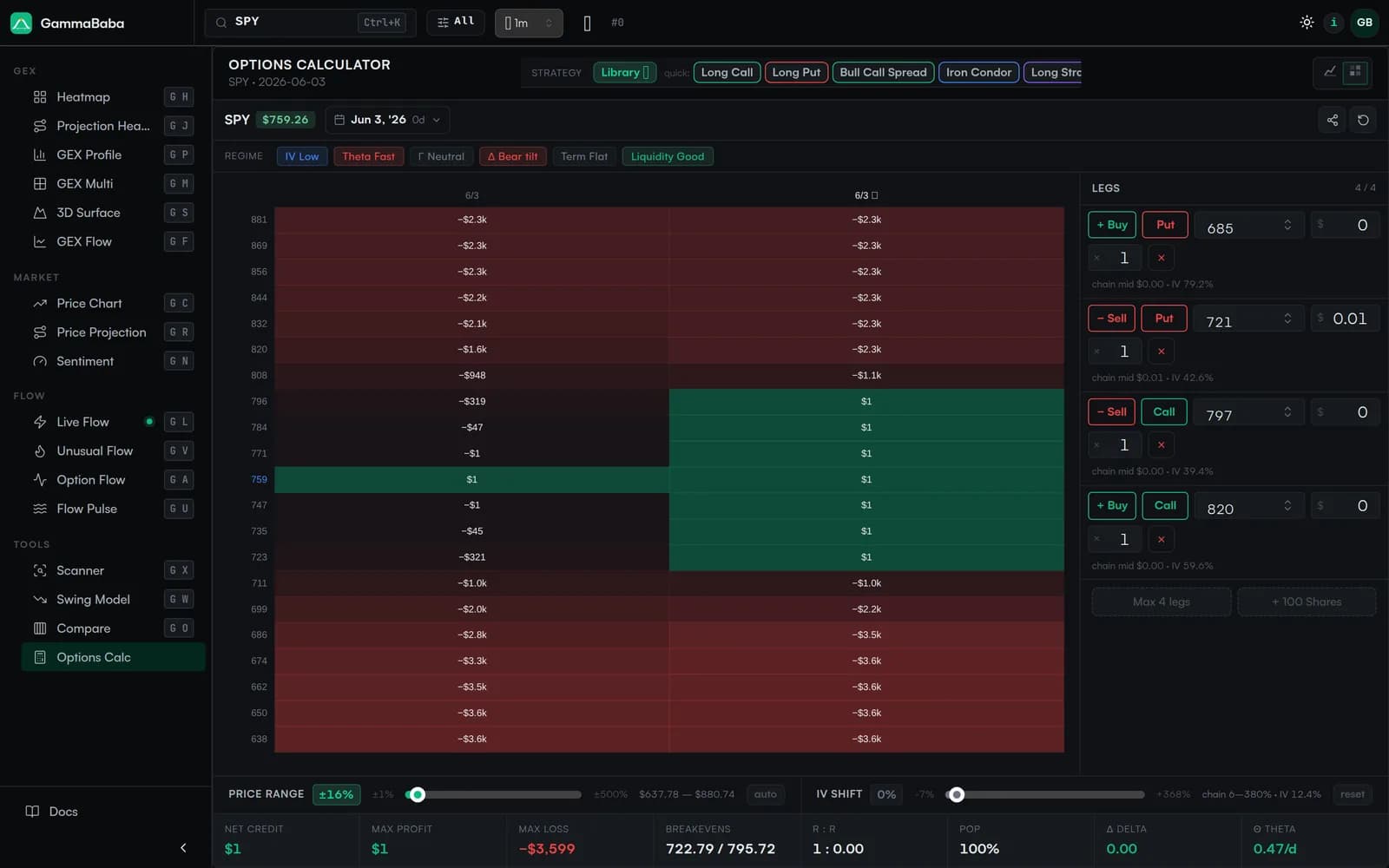
On the chain, IV typically dips near the money and lifts at the wings — the volatility “smile.” You will also see IV differ across expirations, which forms the term structure. For the mechanics of how IV feeds option pricing and payoffs, see the Options Calculator guide.
The Greeks: delta and friends#
The options Greeksmeasure how a contract’s value responds to change. Most chains surface delta by default, and it carries two readings at once. First, it is a speedometer: a 0.50 delta means the option gains about $0.50 (or $50 per contract) for every $1 the stock rises. Second, it is a rough probability: a 0.50-delta call has roughly even odds of finishing in the money, while a 0.13-delta call is a cheap long shot with about a 13% chance.
In the example chain, delta steps down smoothly from 0.82 deep in the money to 0.07 far out — a clean map of risk versus payoff. The other Greeks fill in the rest of the picture:
| Greek | Measures | Practical read |
|---|---|---|
| Delta | Sensitivity to the underlying | 0.50 ≈ moves $0.50 per $1; also a rough probability of finishing in the money. |
| Gamma | How fast delta changes | Highest at the money and near expiry; small moves swing delta hard. |
| Theta | Time decay per day | Negative for buyers; the option loses value each day the stock sits still. |
| Vega | Sensitivity to implied volatility | Long options gain when IV rises and lose when it falls. |
Gamma is also the engine behind dealer hedging and the “walls” that can pin price — the aggregate version of that is covered in Total Gamma Exposure.
Open interest vs volume#
Two columns measure crowding, and traders routinely confuse them. What does open interest mean in options? It is the total number of contracts that are currently open — positions that have been established and not yet closed or exercised. It carries over from day to day and only changes as positions are opened or closed. Options volume, by contrast, counts contracts traded today and resets to zero each morning.
Together they tell you about liquidity — how easily you can get in and out. The bar chart below plots open interest by strike for our example chain. The at-the-money $100 strike carries the most standing positions, which is typical: liquidity concentrates around the money and at round numbers.
Open interest by strike — illustrative
When you screen a chain for a tradable contract, demand all three of these at once:
- Healthy open interest — enough standing contracts that you are not the only participant.
- Active volume — real trading today, so quotes are live and fillable.
- A tight bid-ask spread — the practical proof that the contract is liquid.
Expiration and time decay#
Every option also has an expiration date, a hard deadline after which it is worthless unless it finishes in the money. The further out the expiration, the more an option costs, because there is more time for the stock to move. That extra value bleeds away through time decay (theta), and the bleed accelerates as expiry approaches.
- Weekly options expire most Fridays and decay fast — short-term, high-leverage, high-stress.
- Monthly options typically expire the third Friday of the month and give a position more room to breathe.
Reading option chains on GammaBaba#
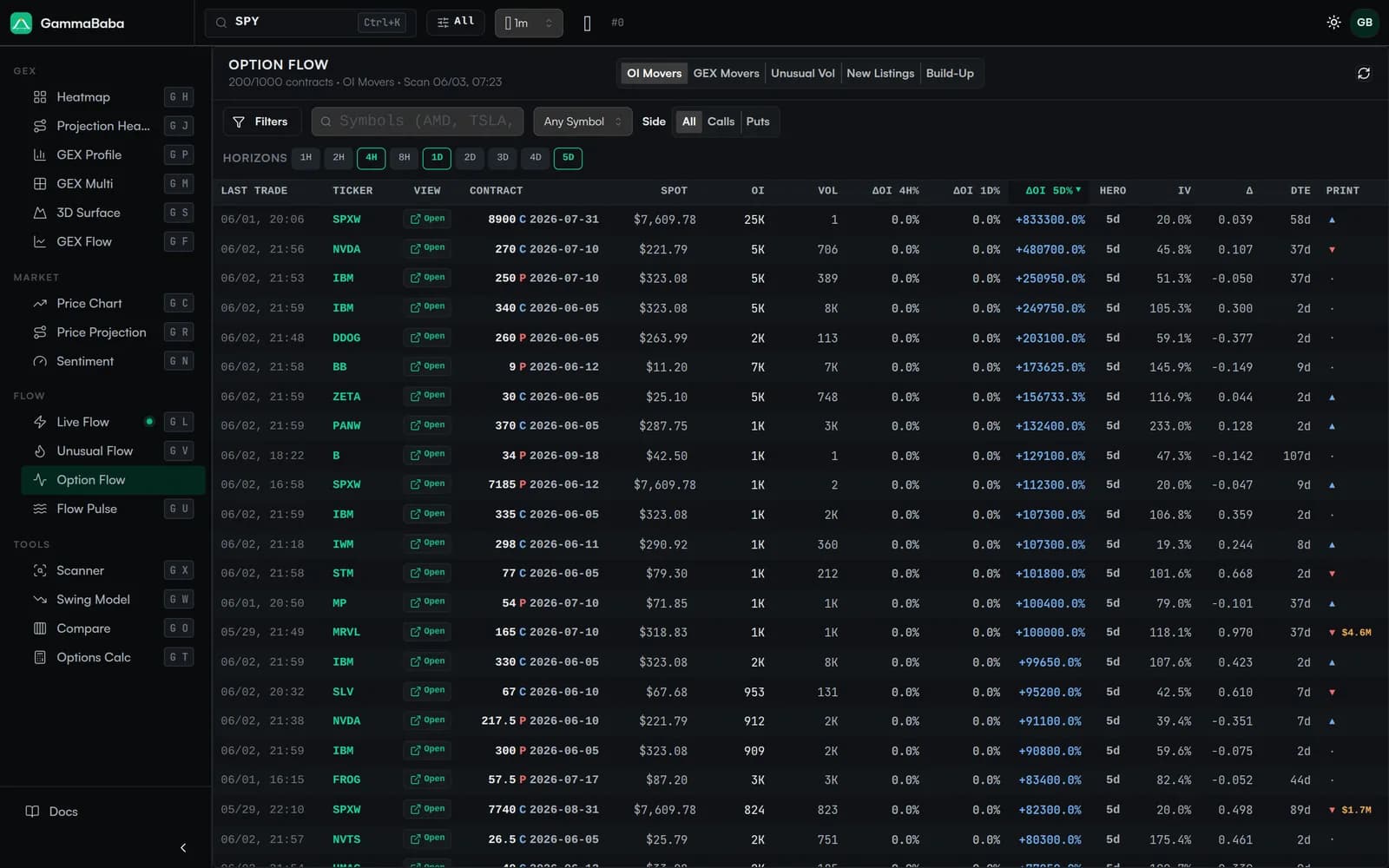
GammaBaba computes and refreshes option chain data across the full US options universe through the session. The Scanner filters the whole universe for liquid, unusual or momentum contracts, and Option Flow surfaces OI movers, GEX movers and unusual volume across thousands of strikes — with the live prints hitting each one, so you can see where size is actually trading.
Frequently asked questions
What is an option chain?
An option chain is the full quote table for a single underlying. It lists every available strike and expiration, split into calls and puts, with columns for bid, ask, implied volatility, the Greeks, open interest and volume. Each row is one tradable contract, so reading across the row gives you a complete view of its price and liquidity.
What does open interest mean in options?
Open interest is the total number of option contracts at a given strike and expiration that are currently open — positions that have been established and not yet closed or exercised. Unlike volume, it carries over from day to day and only changes when positions are opened or closed. High open interest signals a crowded, liquid contract.
What is the difference between volume and open interest?
Volume counts the number of contracts traded today and resets to zero each morning, so it reflects current activity. Open interest counts all standing open positions and persists across sessions. A volume spike well above open interest often signals fresh new positioning, while high open interest with low volume points to settled, established positions.
How do I read the bid and ask on an option chain?
The bid is the highest price buyers are offering and the ask is the lowest price sellers will accept. The gap between them is the bid-ask spread, an effective cost you pay entering and exiting. Aim to transact near the mid-point, and compare the spread to the premium as a percentage — a wide spread relative to price signals an illiquid contract.
What does delta tell me in options data?
Delta measures how much an option's price changes for a $1 move in the underlying — a 0.50 delta gains about $0.50 (or $50 per contract) per $1. It also approximates the probability the option finishes in the money, so a 0.50-delta option is roughly even odds and a 0.10-delta option is a low-probability long shot.
How do I find liquid options to trade?
Look for three things together on the option chain: healthy open interest so positions already exist, active daily volume so quotes are live, and a tight bid-ask spread relative to the premium. Contracts near the money and at round-number strikes are usually the most liquid, and a scanner can filter the whole universe for these conditions at once.