Call Option Graphs: How to Read the Payoff Diagram
A call option graph turns a contract into a single, readable line: where you lose, where you break even, and where you start to profit. Once you can read that line — the flat loss floor, the kink at the strike, the 45° climb above breakeven — call option analysis stops being abstract and becomes a quick visual check. This guide walks through how to read a call option graph using clear payoff diagrams, with GammaBaba’s calculator as the worked example.
What a call option graph shows#
A call option gives you the right, but not the obligation, to buy 100 shares of the underlying at a fixed strike price before expiration, in exchange for an upfront premium. A call option graph — more precisely an option payoff diagram — plots that contract’s profit and loss at expiration against every possible price of the underlying.
- X-axis: the price of the underlying stock or index at expiration.
- Y-axis: your profit (above zero) or loss (below zero) on the position.
- The zero line: where the payoff line crosses it is the breakeven price.
Reading a long call payoff diagram#
Take a stock trading at $50 and buy the 50-strike call for a premium of $2.50 ($250 for one contract of 100 shares). The graph below is exactly what an options profit calculator draws: loss in red, profit in green, with the breakeven marked where the line crosses zero.
Long call — profit / loss at expiration (one contract)
Notice the shape. Below the strike the line is flat — you lose the full premium no matter how far the stock falls. At the strike the line bends. Above breakeven it climbs at 45°, gaining a dollar of profit for every dollar the stock rises. That kink at the strike is where gamma, the rate of change of delta, is highest.
The three payoff regions#
Every long call graph divides into three regions. Knowing the formula for each lets you read any call option graph at a glance, whatever the strike and premium:
| Region | P/L per share | Outcome |
|---|---|---|
| Below strike (price ≤ K) | −P | Maximum loss — the option expires worthless and you lose the full premium. |
| At the strike (price = K) | −P | Still a full loss: zero intrinsic value can’t recover the premium paid. |
| Strike to breakeven (K < price < K + P) | (price − K) − P | A partial loss — intrinsic value offsets some, but not all, of the premium. |
| At breakeven (price = K + P) | 0 | Neither gain nor loss; intrinsic value equals the premium paid. |
| Above breakeven (price > K + P) | (price − K) − P | Profit grows dollar-for-dollar with the stock — uncapped upside. |
For our example, K is 50 and P is 2.50, so breakeven sits at $52.50. The stock has to clear the strike and the premium before the position turns profitable — being right on direction is not enough on its own.
Intrinsic vs extrinsic value#
The premium you pay is made of two parts, and a call option graph helps you separate them. Intrinsic value is what the option is worth if exercised right now — for a call, that is the amount the stock sits above the strike (and never less than zero). Extrinsic value is everything else: the time and volatility premium that the option carries until expiration.
- In the money (price > strike): positive intrinsic value. A $55 stock makes the 50 call worth at least $5 intrinsic.
- At the money (price = strike): zero intrinsic value; the premium is all extrinsic.
- Out of the money (price < strike): zero intrinsic value; the option lives entirely on time and volatility.
Extrinsic value erodes as expiration approaches — that is time decay (theta). Higher implied volatility inflates extrinsic value, which is why earnings and other catalysts make options expensive. On the payoff diagram, the at-expiration line shows intrinsic value only; before expiry the true value curves above it by the remaining extrinsic value. For the mechanics of pricing those pieces, see our options calculator guide.
The other side: a short call graph#
Every call has a seller, and the seller’s graph is the mirror image. When you sell (write) a call, you collect the premium upfront, so your best case is keeping it — a capped profit equal to the premium. The risk profile flips: profit is limited, and loss grows as the stock rises above the strike.
Short call — profit / loss at expiration (one contract)
The two graphs share the same strike and the same breakeven at $52.50 — they simply reflect across the zero line. A naked short call carries the same theoretically unlimited risk that a long call has as upside, which is why most traders sell calls only against stock they own (a covered call) or as one leg of a defined-risk spread. To weigh the buyer’s and seller’s perspectives side by side, read Call vs Put Options.
From graph to decision on GammaBaba#
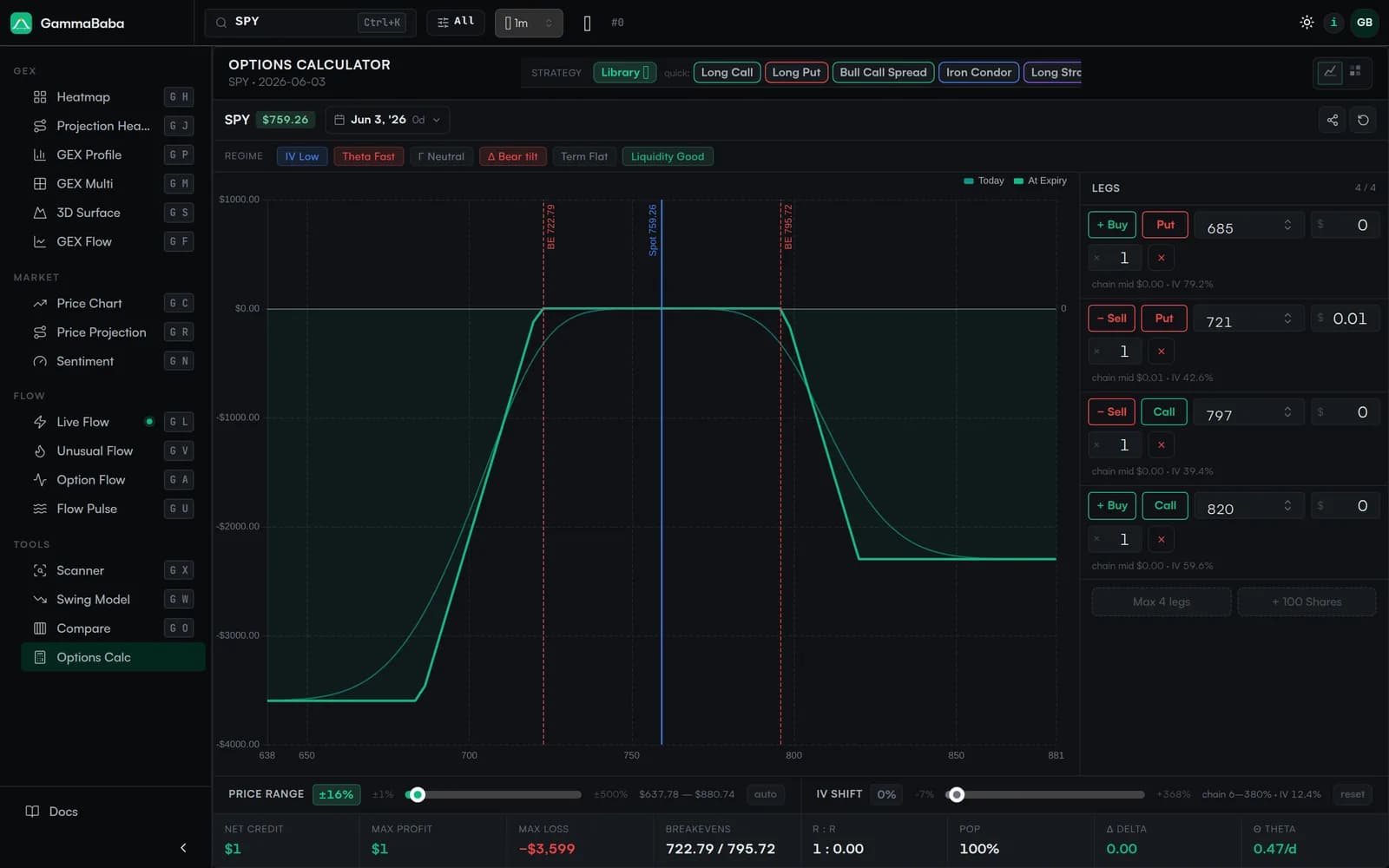
A static textbook graph is fine for learning, but real trades move. GammaBaba’s Options Calculator draws the payoff diagram live: pull real strikes and premiums from the chain, drag the price and date, and watch the line and breakeven redraw as you change inputs. The accompanying P/L table reads out profit and loss across price and time, so you can see how the position behaves days before expiration — not just on the final day.
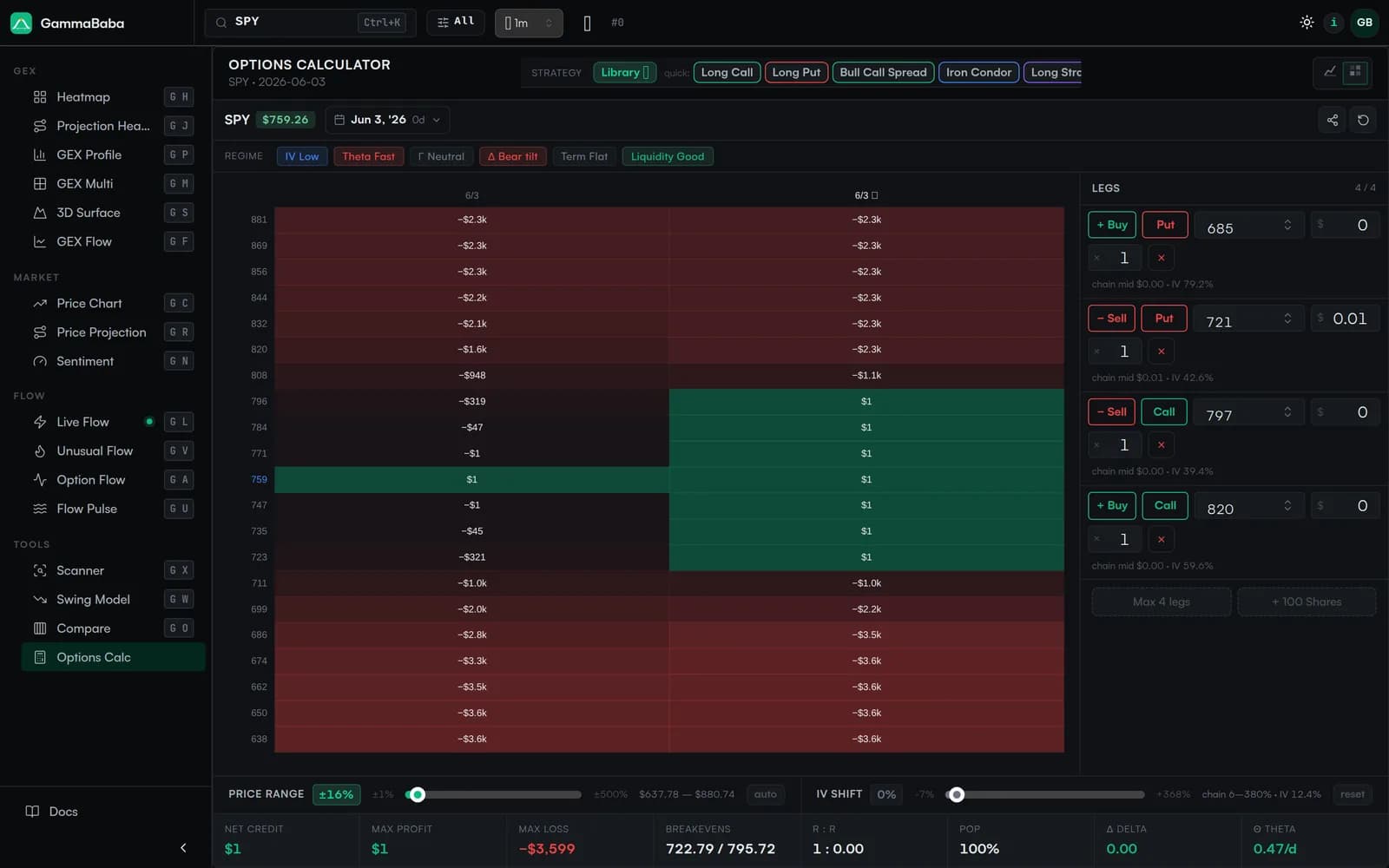
Reading the graph is only half the discipline. Many losing trades come from misreading the diagram — confusing max profit with likely profit, or ignoring time decay. Our guide to common options trading mistakes covers the traps that a payoff diagram is meant to keep you out of.
Frequently asked questions
How do you read a call option graph?
Read the x-axis as the price of the underlying at expiration and the y-axis as your profit or loss. For a long call the line is flat below the strike (you lose the full premium), bends at the strike, and slopes up once price clears breakeven, which is the strike plus the premium. Profit above breakeven is uncapped; the maximum loss is the premium paid.
What is the breakeven on a call option?
The breakeven on a long call is the strike price plus the premium paid per share. At that underlying price the option's intrinsic value exactly equals what you paid, so the position neither gains nor loses at expiration. The stock has to finish above that level for the trade to profit.
What is the difference between intrinsic and extrinsic value?
Intrinsic value is what a call is worth if exercised now — the amount the underlying sits above the strike, and never less than zero. Extrinsic value is the rest of the premium: the time and implied-volatility value that decays toward zero by expiration. An at-expiration payoff graph shows intrinsic value only.
What does a short call payoff diagram look like?
A short (written) call is the mirror image of a long call. The seller collects the premium, so the graph is flat at a small profit (the premium) below the strike, then slopes downward above breakeven as losses grow with the stock. Profit is capped at the premium; the risk is open-ended unless the call is covered by stock or part of a spread.
Why does a call option lose money even when the stock goes up?
Two reasons. First, the stock has to clear breakeven (strike plus premium), so a small rise above the strike can still leave a partial loss. Second, time decay erodes the option's extrinsic value every day, so a slow move up can lose to theta even as intrinsic value builds.
What is moneyness for a call option?
Moneyness describes where the underlying sits relative to the strike. A call is in the money when the price is above the strike (positive intrinsic value), at the money when price equals the strike, and out of the money when price is below the strike (zero intrinsic value, all extrinsic).