How to Use an Options Calculator: Price, Greeks & Profit
An options calculator turns the abstract math of a contract into a picture you can act on: what the option is worth today, where it breaks even, how much you can make or lose, and how that changes as price, time and volatility move. This guide shows what an options profit calculator does, the inputs that drive it, and how to read the output — using GammaBaba’s own calculator as the worked example.
What an options calculator actually does#
Every option has a fair value that depends on a handful of measurable inputs. An option price calculator takes those inputs, runs them through a pricing model, and returns a theoretical value plus the option’s sensitivities (the Greeks). An options profit calculator goes one step further and maps your profit and loss across a whole range of prices at — and before — expiration.
You typically reach for one to answer three questions:
- What is this worth? Estimate a fair option price so you are not overpaying the spread.
- What can I make or lose? See max profit, max loss and breakeven before you commit.
- What happens if I am wrong on timing or volatility? Stress-test the trade against time decay and an IV change.
The inputs: what drives an option's price#
The industry-standard framework is the Black–Scholes model (with extensions for American-style and dividend-paying options). You do not need to solve the formula by hand — but you should know what each input does, because changing any of them changes the price.
| Input | What it changes |
|---|---|
| Underlying price | The single biggest driver. Calls gain value as price rises; puts gain as it falls. |
| Strike price | Your chosen reference level. Sets how far in- or out-of-the-money the option is. |
| Time to expiration | More time = more value. That extra value (extrinsic value) decays toward zero by expiry. |
| Implied volatility (IV) | Higher IV = richer option. An IV drop after an event (“IV crush”) can sink a long option even if you were right on direction. |
| Risk-free rate | A small upward push on calls, downward on puts. Matters most for long-dated options. |
| Dividends | Expected dividends lower call values and raise put values before the ex-date. |
Worked example: a long call#
Say a stock trades at $100 and you buy the 100-strike call for a premium of $3.50 ($350 for one contract of 100 shares). The payoff diagram below is exactly what an options profit calculator draws — profit in green, loss in red, with the breakeven marked where the line crosses zero.
Long call — profit / loss at expiration (one contract)
Notice the bend: the loss is capped and flat below the strike, then the line slopes up at 45° once price clears breakeven. That kink at the strike is where gamma — the rate of change of delta — is highest. For a closer look at how a call’s payoff curve bends before expiry, see Call Option Graphs.
Reading the Greeks#
The Greeks are the option’s sensitivities. A good option Greeks calculator shows all of them so you understand why the price moves, not just that it does.
| Greek | Measures | Practical read |
|---|---|---|
| Delta | Price sensitivity to the underlying | 0.50 ≈ moves $0.50 per $1; also a rough probability of finishing in the money. |
| Gamma | How fast delta changes | Highest at the money and near expiry — small moves swing your delta hard. |
| Theta | Time decay per day | −0.05 means the option loses ~$5/day, all else equal. Accelerates into expiry. |
| Vega | Sensitivity to implied volatility | 0.10 means +1 vol point adds ~$10 of value. Long options are long vega. |
| Rho | Sensitivity to interest rates | Usually small; matters mainly for long-dated (LEAPS) positions. |
Beyond a single leg: multi-leg strategies#
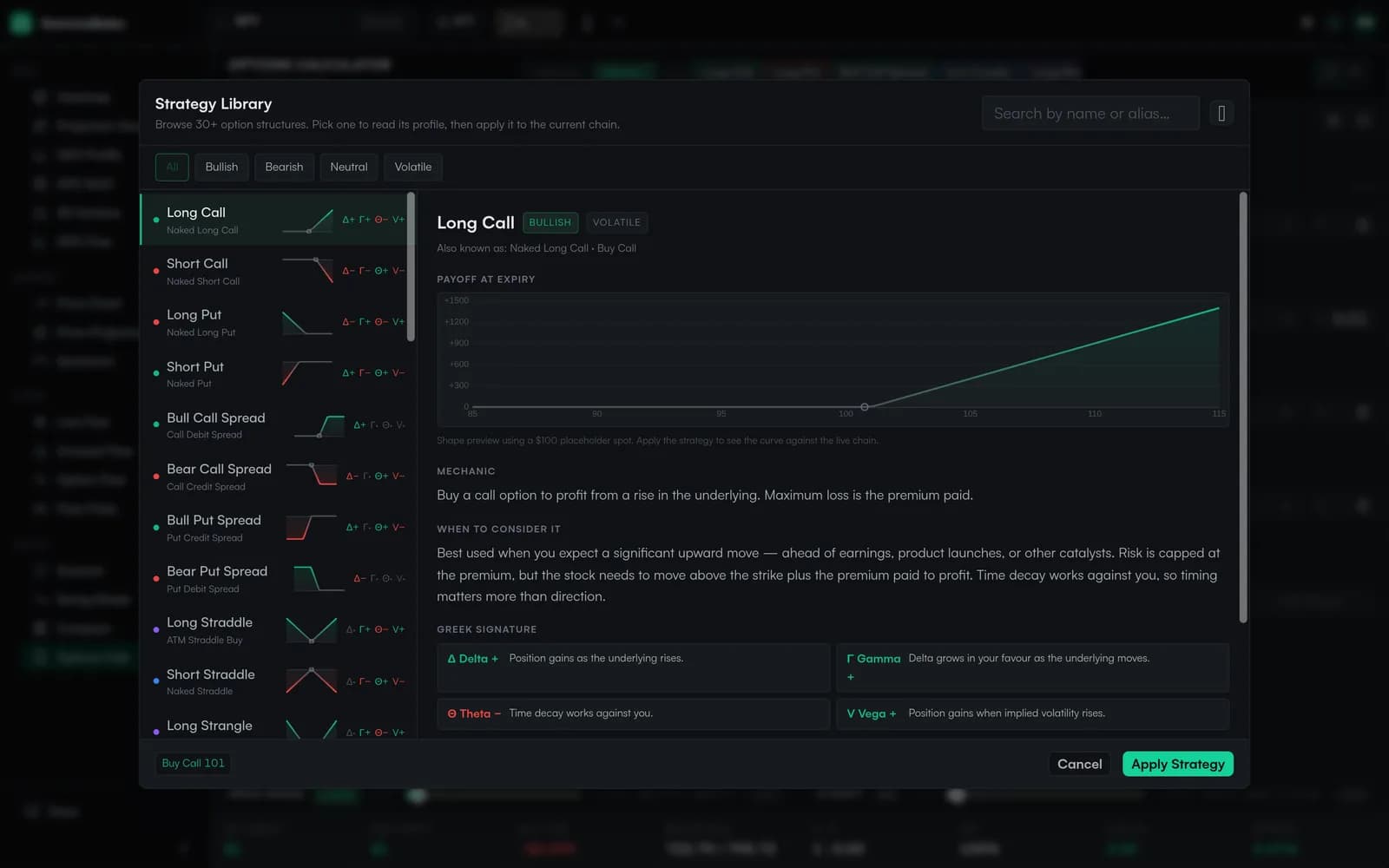
A options strategy calculator shines when you combine legs. A bull call spread — buy the 100 call, sell the 105 call — caps both your cost and your profit. The same payoff engine simply sums the legs:
Bull call spread — defined risk, defined reward
Selling the 105 call cuts your cost from $350 to $200 and lowers breakeven from $103.50 to $102 — at the price of capping profit at $300. That trade-off is the whole point of spreads, and a calculator makes it visible instantly.
Breakevens and probability of profit#
Two outputs separate a serious tool from a toy. Breakeven is the price where the position turns from loss to profit (the dots on the diagrams above). Probability of profit (PoP) estimates the odds of finishing past breakeven, derived from the option’s implied volatility and time to expiry. A high max profit with a low PoP is often a worse trade than a modest, high-probability one — and a calculator lets you compare them on equal footing.
Try it on GammaBaba#
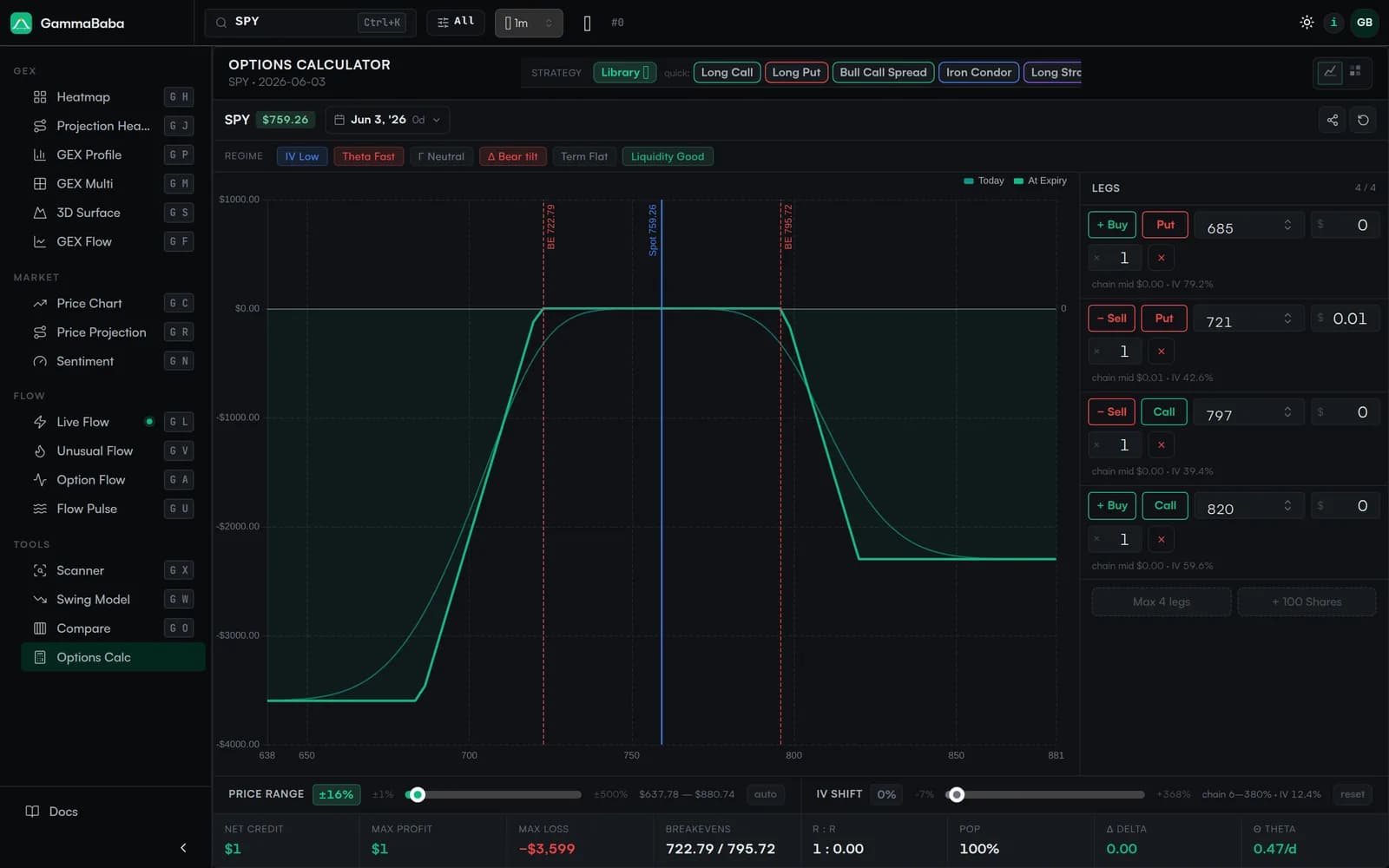
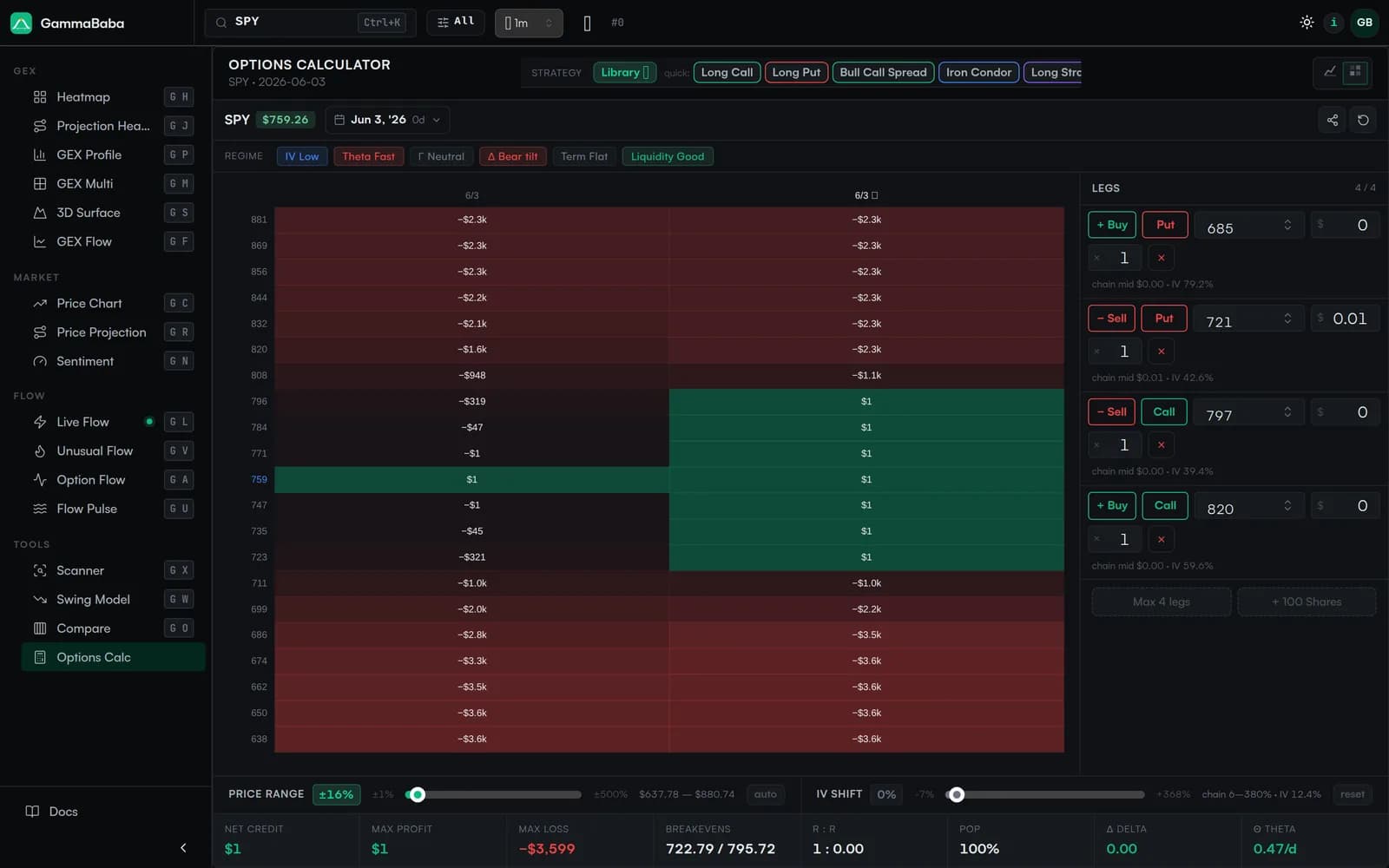
GammaBaba’s Options Calculator is a live, multi-leg tool: pull real strikes and premiums from the chain, stack up to several legs (or load a preset like a spread, straddle or iron condor), and read the payoff, breakevens, max profit/loss, probability of profit and position Greeks at a glance.
Common mistakes when using an options calculator#
- Using stale IV. Plug in current implied volatility, not last week’s — it is the input most likely to be wrong.
- Ignoring the date slider. Expiration-only payoff hides theta. Always check P/L a few days out, too.
- Forgetting the multiplier. One equity contract controls 100 shares; a $0.50 move in the option is $50 in your account.
- Mistaking max profit for likely profit. Pair it with probability of profit and breakeven.
These overlap with the broader options trading mistakesevery new trader should know — and if you are still choosing between a call and a put, start with Call vs Put Options.
Frequently asked questions
What is an options calculator?
An options calculator is a tool that estimates an option's fair price and maps your profit and loss across a range of underlying prices. It uses inputs like the stock price, strike, time to expiration, implied volatility and interest rates, typically based on the Black–Scholes model, and reports the option's Greeks alongside breakeven, max profit and max loss.
How do you calculate option profit?
Profit on a long option at expiration equals its intrinsic value minus the premium you paid, multiplied by 100 (the contract multiplier). For a long call: profit = (max(price − strike, 0) − premium) × 100. A calculator does this across every price so you can see the full payoff curve and the breakeven point.
What is the breakeven on an option?
Breakeven is the underlying price where the position neither makes nor loses money at expiration. For a long call it is the strike plus the premium paid; for a long put it is the strike minus the premium. For multi-leg strategies, the calculator finds every point where the payoff line crosses zero.
What does an option Greeks calculator show?
It reports delta (sensitivity to the underlying), gamma (how fast delta changes), theta (daily time decay), vega (sensitivity to implied volatility) and rho (sensitivity to interest rates). Together they explain how and why the option's value will change before expiration.
Is the Black–Scholes price the price I'll pay?
Not exactly. Black–Scholes gives a theoretical value; the price you actually pay is the market's bid/ask, which reflects supply, demand and the current implied volatility. A calculator helps you judge whether the quoted price is rich or cheap relative to fair value.