Call vs Put Options: Key Differences & Payoffs Explained
A call is the right to buy; a put is the right to sell. That single distinction drives everything else — which direction you profit from, how much you can lose, where the trade breaks even, and how the payoff curve bends. This guide makes the difference between call and put concrete with side-by-side payoff diagrams and a comparison table you can act on.
What is a call option, and what is a put option?#
An option is a contract on an underlying asset — usually 100 shares of a stock or an index. It gives the buyer a right (not an obligation) to transact at a fixed strike price before the contract expires, in exchange for an upfront premium. There are only two kinds, and the whole of call options explained versus puts comes down to which side of the trade the right sits on:
- Call option: the right to buy the underlying at the strike. You buy a call when you expect the price to rise. The call gains value as the underlying climbs above the strike.
- Put option: the right to sell the underlying at the strike. You buy a put when you expect the price to fall, or to protect shares you already own. The put gains value as the underlying drops below the strike.
What is a put option? A worked example#
Suppose you own 100 shares of a stock trading at $100 and you are worried about a pullback next month. You buy a 100-strike put for a premium of $3.00 ($300 for one contract). If the stock falls to $80, your shares lost $2,000 of value — but your put now lets you sell at $100, offsetting most of the drop. That is the protective side of what is a put option: it behaves like insurance on a position, with the premium as the cost of the policy.
The same put bought without owning the shares is simply a bearish bet: it rises in value if the stock falls. The payoff diagram below shows that profile — loss capped at the $300 premium, profit growing as price drops toward zero.
Long put — profit / loss at expiration (one contract)
Note the shape: flat loss above the strike (the option expires worthless and you lose only the premium), then a rising line below it. Breakeven sits at strike minus premium, or $100 − $3.00 = $97. Below $97 the put is in profit.
The call side: profit on the way up#
Now flip it. To get call options explained with the same numbers: a stock trades at $100, and you buy the 100-strike call for a premium of $3.50 ($350 for one contract) because you expect the price to rise. Your risk is capped at the premium; your upside is theoretically unlimited because there is no ceiling on how high the stock can go.
Long call — profit / loss at expiration (one contract)
The mirror image of the put is obvious side by side: the call is flat-then-rising as price increases, the put is flat-then-rising as price decreases. For a call, breakeven is strike plus premium — $100 + $3.50 = $103.50. The kink at the strike on both diagrams is where the option transitions from out-of-the-money to in-the-money, and it is where gamma — the rate of change of delta — is highest.
Difference between call and put, side by side#
Here is the full call option vs put option comparison in one view. Every row flows from that first distinction — the right to buy versus the right to sell:
| Call option | Put option | |
|---|---|---|
| Right at the strike | Right to buy | Right to sell |
| You profit when price | Rises (bullish) | Falls (bearish) |
| Max loss (buyer) | Premium paid ($350) | Premium paid ($300) |
| Max profit (buyer) | Unlimited (no upside cap) | Strike − premium, down to $0 |
| Breakeven | Strike + premium = $103.50 | Strike − premium = $97.00 |
| Common use | Leveraged upside bet | Hedge / bearish bet |
Buying vs selling: two sides of every contract#
So far we have looked at buying calls and puts. Every contract has a seller (writer) on the other side, and their payoff is the mirror image. The seller collects the premium upfront but takes on an obligation if the buyer exercises:
- Selling a put obligates you to buy the shares at the strike if assigned. Sellers do this to collect premium and are willing to own the stock at that level.
- Selling a call obligates you to sell shares at the strike. Covered (you own the shares) it caps upside for income; uncovered it carries unlimited risk.
For buyers, risk is always capped at the premium. For uncovered sellers it is not — which is why direction, breakeven and position size matter more on the sell side. The options glossary defines assignment, exercise and moneyness in detail if any of those terms are new.
How to choose: which one, and when#
Picking between a call and a put starts with direction, then narrows on strike, expiration and implied volatility. The difference between call option and put option in practice is rarely just bullish-or-bearish — it is about matching the contract to a specific view:
- Expect a move up? Buy a call. Pick a strike and expiration that give the move time to play out past breakeven.
- Expect a move down, or want a hedge? Buy a put. As protection, size it to the shares you want to cover.
- Direction matters, but so does cost. Volatility inflates premiums; a high implied volatility makes both calls and puts more expensive to buy.
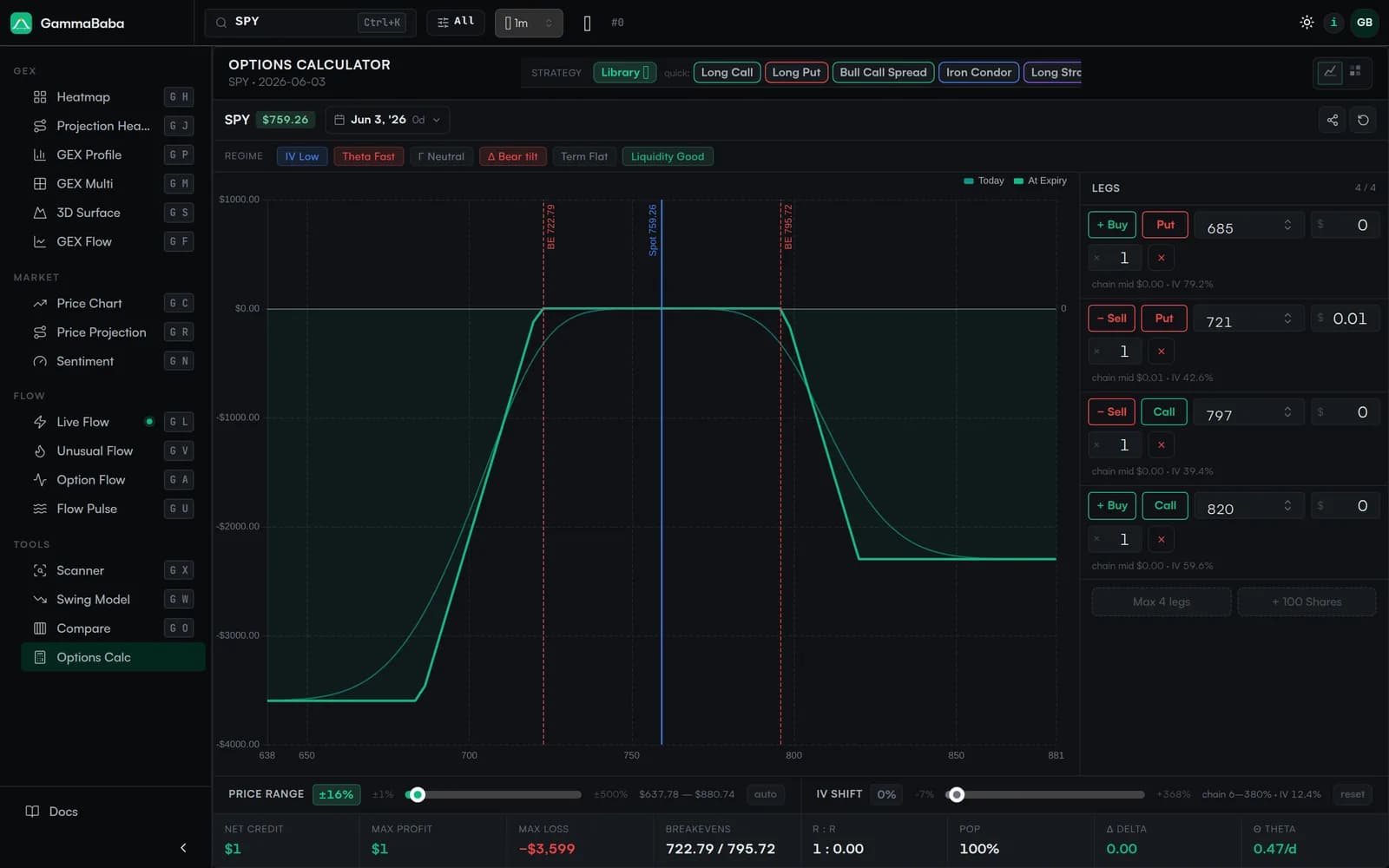
Whatever you pick, model it before you commit. GammaBaba’s Options Calculator draws exactly the payoff curves shown above from live strikes and premiums, marks the breakevens, and reports max profit, max loss and the Greeks so the trade-off is visible before you place an order.
Frequently asked questions
What is the difference between a call and a put option?
A call option gives the buyer the right to buy the underlying at the strike price, so it profits when the price rises. A put option gives the buyer the right to sell at the strike price, so it profits when the price falls. Both cost an upfront premium, which is the buyer's maximum loss.
What is a put option in simple terms?
A put option is a contract that gives you the right to sell an asset at a fixed strike price before expiration. Buyers use puts to profit from a falling price or to protect shares they already own, similar to insurance. The most a put buyer can lose is the premium paid for the contract.
When should I buy a call vs buy a put?
Buy a call when you expect the underlying price to rise, because a call gains value as price moves above the strike. Buy a put when you expect the price to fall or want to hedge a long position, because a put gains value as price moves below the strike. Match the strike and expiration to the size and timing of the move you expect.
How do I calculate the breakeven on a call or a put?
For a long call, breakeven is the strike price plus the premium paid. For a long put, breakeven is the strike price minus the premium paid. For example, a 100-strike call bought for 3.50 breaks even at 103.50, and a 100-strike put bought for 3.00 breaks even at 97.00.
What does buy call sell put mean?
Buy call sell put is a bullish, directional strategy where a trader buys a call and sells a put at the same time. Both legs profit if the underlying rises: the long call gives leveraged upside, and the short put collects premium while obligating the trader to buy the stock at the strike if assigned. It carries more risk than a single long option.
Can you lose more than the premium on options?
If you buy a call or a put, your maximum loss is the premium you paid. If you sell options, the risk profile is different: a covered position limits risk, but selling uncovered calls can carry unlimited risk, and selling puts obligates you to buy the shares at the strike. Always check max loss before placing the trade.