🧭 Projection Heatmap
The GEX Heatmap shows you the landscape as it stands today. The Projection Heatmap adds a direction: it draws an expected price path across the expiration columns, connecting the gamma magnets that tend to attract or repel price along the way. Instead of asking only “where is the gamma right now?” it asks “given this gamma structure, where might price be pulled over the coming sessions and expiries?”
What the Projection Heatmap Shows#
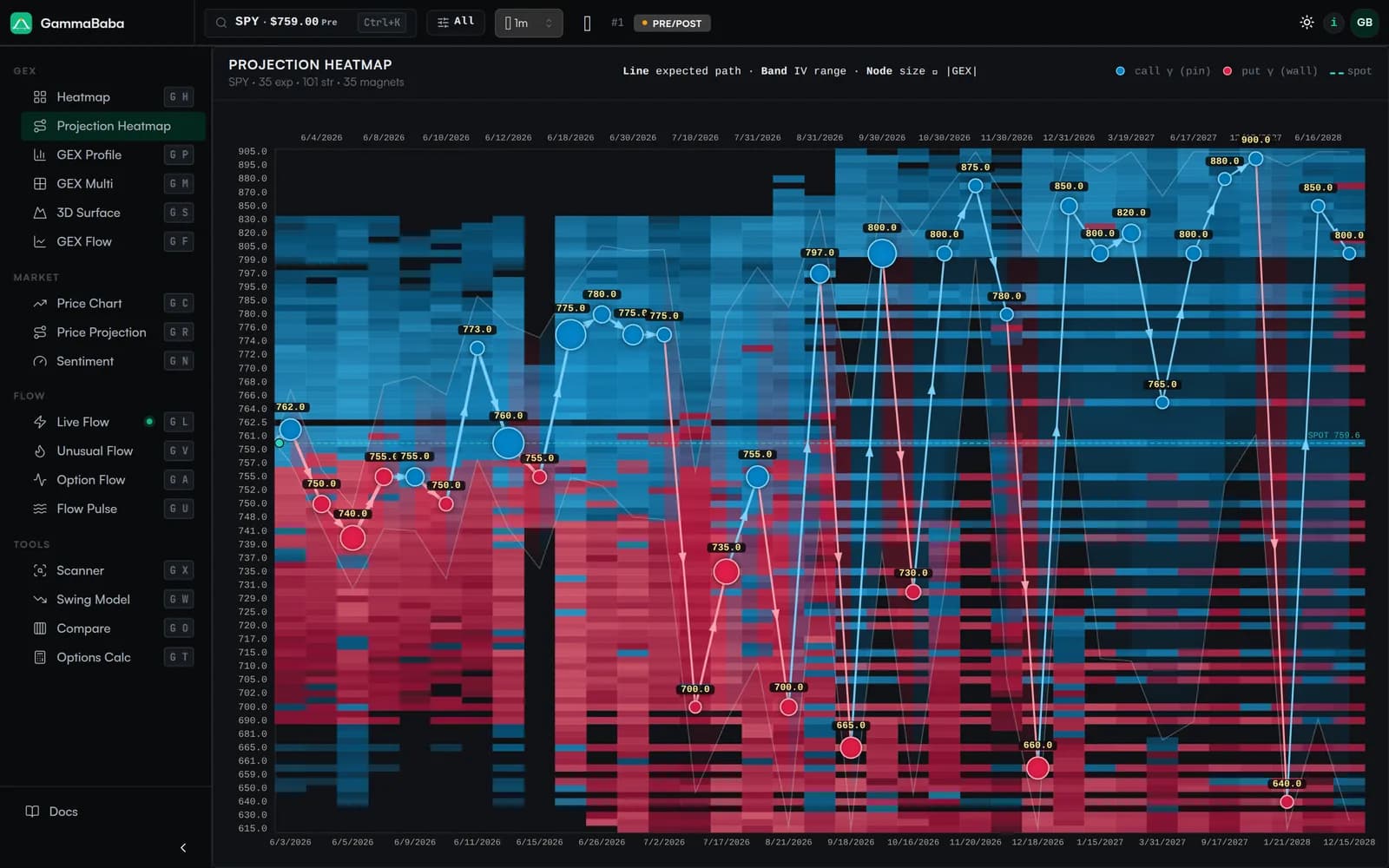
The chart keeps the familiar GEX grid in the background — strikes run up the vertical axis, expirations across the horizontal axis, and each cell is shaded by its gamma exposure. On top of that grid, the Projection Heatmap overlays three forward-looking layers:
- The expected path (line) — a connected line that steps from one expiration to the next, tracing where the gamma structure suggests price could gravitate as each expiry approaches.
- Magnet nodes (markers) — each point on the path sits at a magnet strike. Their size scales with the magnitude of gamma at that level, so heavier magnets read as larger nodes.
- The spot reference — a dashed line marks the current underlying price, giving you an anchor for how far each projected magnet sits above or below where price trades now.
The header summarizes the active view at a glance — for example the number of expirations, strikes and magnets currently in play — so you always know how much of the surface the projection is drawn across.
Pins vs. Walls: Reading the Magnets#
Every node on the path is one of two kinds of magnet, and the distinction is the heart of the tool:
- Call-gamma pins — strikes stacked with call gamma tend to attract price. As an expiry nears, hedging flow around heavy call gamma can hold price close to the level, which is why these act like “pins.”
- Put-gamma walls — strikes stacked with put gamma tend to repel price. They often behave like a floor or barrier that price struggles to push through, which is why these read as “walls.”
Stringing the nearest dominant magnets together across expirations produces the expected path. Where the line climbs toward a call pin and then drops to a put wall, you are reading a sequence of levels the gamma structure favors — not a guarantee that price will hit each one, but a map of where the pull is strongest.
The King-Fan Magnet Overlay#
On top of the per-expiry pins and walls, the Projection Heatmap layers a king-fan magnet overlay. The King Strike is the level carrying the single heaviest gamma concentration on the surface — the dominant magnet that price often gravitates toward as expiration approaches.
The “fan” projects that dominant pull forward across expirations, fanning out from the current view so you can see how the strongest magnet relates to each column ahead. When the expected path repeatedly bends back toward the king level, that is a sign the surface is organized around one decisive strike rather than a scattered set of weaker magnets.
The Expiry / DTE Horizon Filter#
The projection respects the global expiry / days-to-expiration (DTE) horizon filter. That filter decides how far into the future the grid — and therefore the path — extends:
- A short horizon — narrows the view to near-dated expirations, where gamma is highest and hedging pressure is most immediate. Use it to focus on the next few sessions.
- A longer horizon — extends the path across later expiries, giving a wider sense of where the structure points over the coming weeks and months.
Because the filter is global, the horizon you set here matches the rest of your gamma views — so the path you read on the Projection Heatmap lines up with the strikes and walls you see elsewhere on the platform.
How It Differs from the GEX Heatmap#
The static GEX Heatmap answers “where is the gamma right now?” It is the current landscape — strikes, expirations and the King Strike, shaded by exposure. It is excellent for spotting today’s walls and the levels that may cap or floor the market.
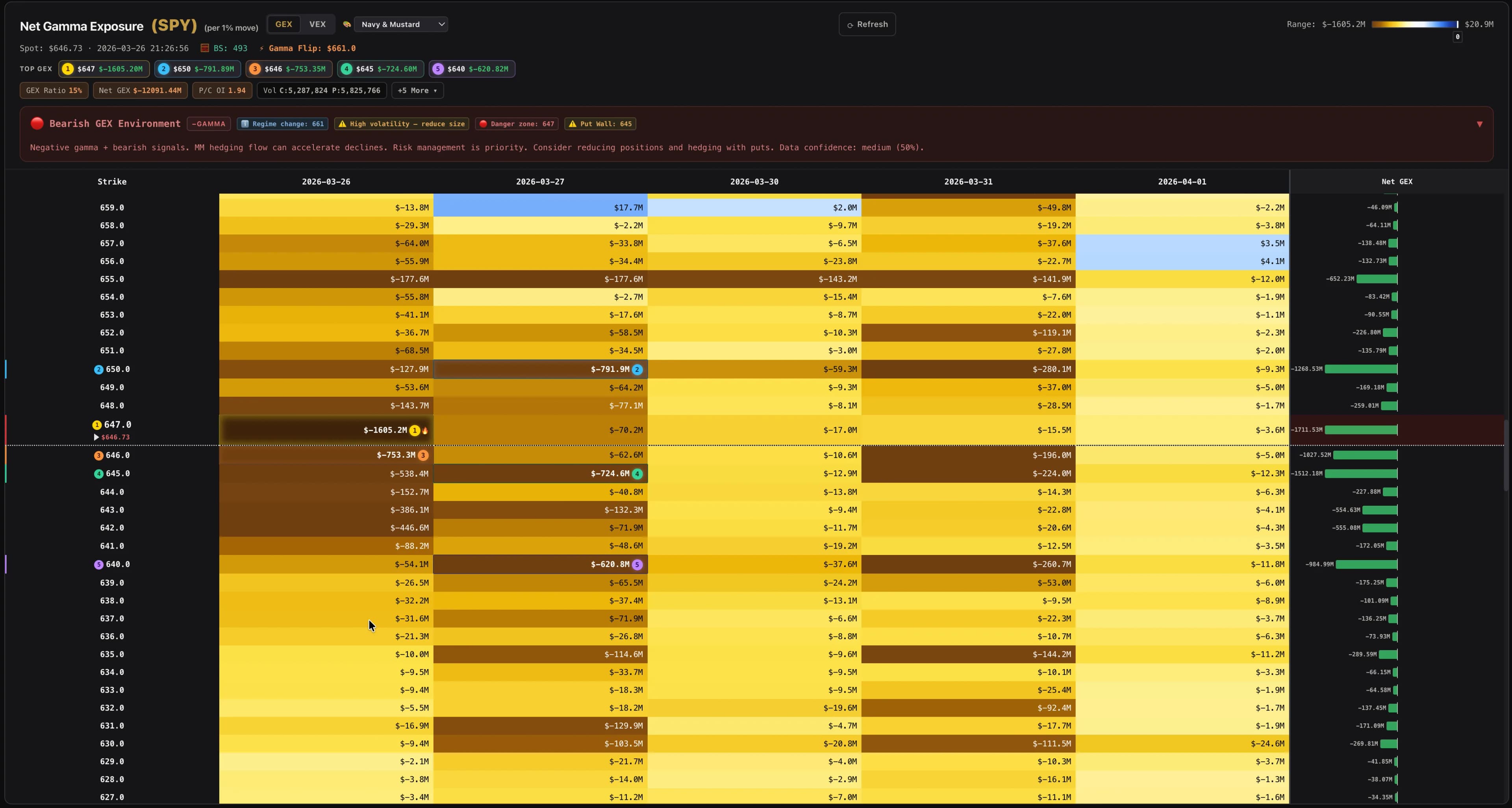
The Projection Heatmap starts from that same grid but adds a forward-looking path. Rather than leaving you to eyeball which walls matter next, it connects the dominant magnets across expirations into an expected route. Think of the GEX Heatmap as the terrain and the Projection Heatmap as a suggested trail through it — same map, with a direction drawn on.
Putting It to Work#
A practical way to use the projection:
- Start at the spot line and note the nearest magnet above and below it — the closest call pin and put wall frame the immediate range.
- Follow the path one expiration at a time. A run of call pins stepping higher suggests upward pull into those expiries; a drop into a put wall flags a level where downside pressure may stall.
- Treat the largest nodes and the king level as your highest-conviction levels, and tighten or widen the DTE horizon to match your trade’s timeframe.
- Confirm against the static GEX Heatmap and the live market — the projection is a hypothesis about the path of least resistance, not a forecast.