📡 Unusual Flow
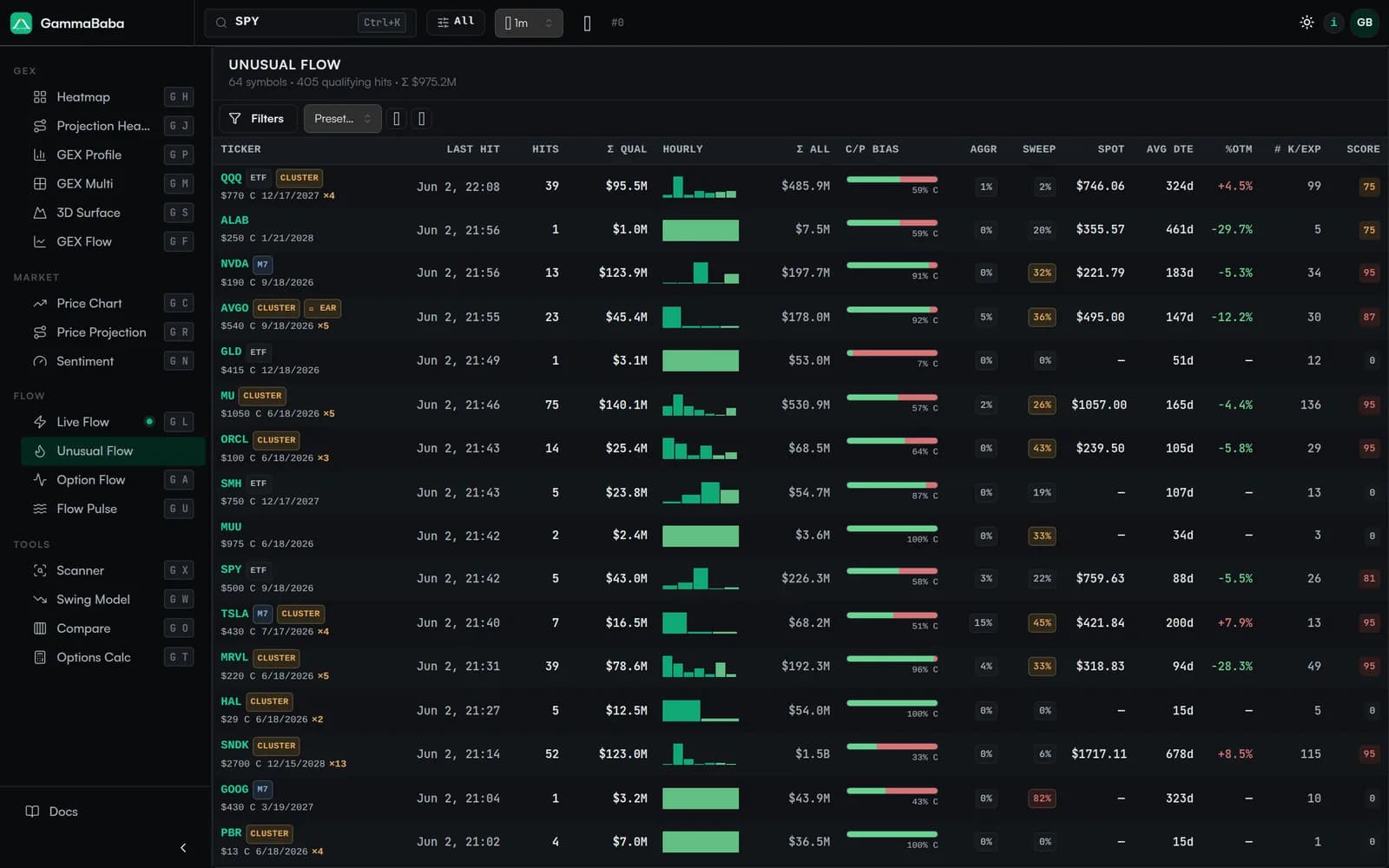
Unusual Flow answers one question across the whole market at once: where is options positioning unusually large right now? Instead of scrolling a per-trade tape, it ranks tickers by how far their options premium has stretched beyond their own normal activity — so a quiet small-cap lighting up registers just as clearly as a mega-cap. Each row condenses the day's flow into a single line: how much qualified, whether it leans calls or puts, whether prints came in as sweeps, and a composite score to sort the noise from the signal.
What Counts as Unusual#
“Unusual” here is relative, not absolute. A ticker qualifies when its options premium is large compared to its own typical activity — not just large in raw dollars. That framing matters: $2M of premium might be routine for a heavily traded mega-cap but extraordinary for a name that usually trades a fraction of that. Ranking against each ticker's own baseline surfaces genuine standouts instead of a list that is permanently dominated by the most liquid symbols.
The header summarizes the current scan — how many symbols qualified, the number of qualifying hits behind them, and the combined premium those hits represent — giving you a quick read on how active and how concentrated the day's positioning is.
Reading a Row#
Each row packs several signals into one line. From left to right, the columns work together to describe both the size and the character of the flow:
- Ticker — the symbol, often carrying badges such as
ETF, an index/basket tag, orEARwhen an earnings event is near. The most active strike and expiration for that name are shown beneath it. - Last Hit & Hits — the time of the most recent qualifying print and how many qualifying prints have stacked up so far.
- Σ Qual — the qualifying premium: the dollar value of the prints that actually met the unusual threshold. This is the figure the ranking leans on.
- Hourly — a mini bar chart of activity through the session, so you can see whether the flow arrived in one burst or built steadily.
- Σ All — total premium across the ticker, giving context for how the qualifying slice compares to the day's full options activity.
- C/P Bias — a horizontal bar showing the call-versus-put split, with the dominant side and its percentage labeled.
- Aggr & Sweep — the share of flow that crossed aggressively into the offer/bid, and the share that came in as sweeps. More on these below.
- Spot, Avg DTE & %OTM — the underlying price, the average days-to-expiration of the qualifying activity, and how far out-of-the-money the positioning skews.
- # K/Exp & Score — how many distinct strike/expiration buckets were involved, and a composite score (covered in its own section) that blends these signals into a single sortable number.
Aggressor, Sweeps and Clusters#
Three flags describe the texture of the flow — the part that hints at intent rather than just size.
- Aggressor — the percentage of premium that traded aggressively, lifting offers or hitting bids rather than resting passively. A high aggressor share suggests a participant willing to pay up to get filled.
- Sweep — the share that arrived as sweeps, where an order is split across multiple exchanges to fill quickly. Sweeps are often read as a sign of urgency or conviction.
- Cluster — a tag, frequently with an ×N count, that appears when repeated qualifying prints stack up on the same name. Clustering shows the activity is not a single outlier ticket but a recurring pattern building through the session.
The Composite Score#
The Score column rolls the row's signals — qualifying premium relative to the ticker's norm, call/put conviction, aggressor and sweep intensity, clustering, and breadth across strikes and expirations — into a single number you can sort on. It is a ranking aid, a way to float the most distinctive setups to the top of a long list, rather than a measure of how a trade will perform.
Sorting by Score is the fastest way to triage the board, but it rewards reading the underlying columns afterward. Two rows can share a high score for very different reasons — one driven by a single enormous swept print, another by dozens of clustered, one-sided hits — and those tell different stories.
Unusual Flow vs. Live Flow#
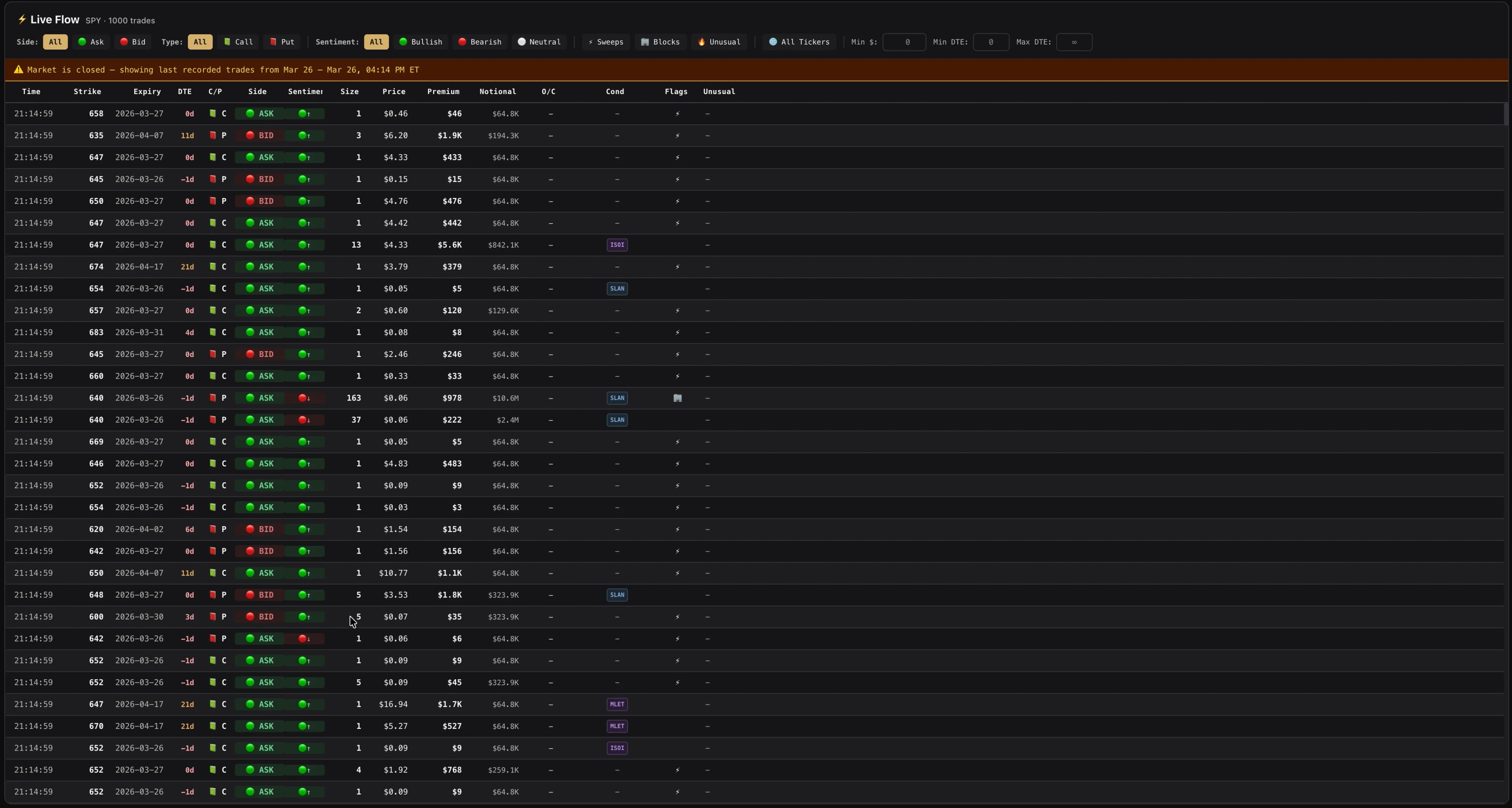
Unusual Flow and Live Flow are complementary views of the same activity at two different zoom levels. Unusual Flow is the aggregate — one row per ticker, ranked across the whole market, built to answer “what is unusual right now?” Live Flow is the tape — a real-time, trade-by-trade feed showing each print's time, strike, expiry, premium, size, price and sweep/block tags.
A natural workflow is to scan Unusual Flow for a standout name, then drop into Live Flow filtered to that ticker to watch the individual prints build — confirming whether the aggregate score is driven by clean, repeated buying or a messier mix of two-sided activity.
A Practical Way to Use It#
- Sort by Score to bring the most distinctive setups to the top of the board.
- Filter to your universe — use the controls and presets to narrow by the characteristics you care about so the list reflects setups you would actually trade.
- Read the texture — check C/P bias, aggressor and sweep share, and whether a cluster tag is present. One-sided, aggressive, clustered flow is a cleaner signal than split, passive activity.
- Note the context — average DTE, %OTM, and an
EARbadge tell you whether the positioning is short-dated and speculative or longer-term, and whether an earnings catalyst is in play. - Drill down — pull the name's chart and GEX profile, and watch the prints arrive in Live Flow before forming a view.